




Top 20 Most Common Bird in Carazo
Amid the bustling tropical dry forests and fertile coffee plantations of Carazo, thrive the 20 most common birds. These avian species exhibit adaptations perfectly suited to this unique environment, from the vivid plumage of trogons, matching the local flora, to the sharp-eyed hunting skills of the peregrine falcon. This plethora of birds showcases each species' strikingly unique behavior and appearance.

Most Common Bird
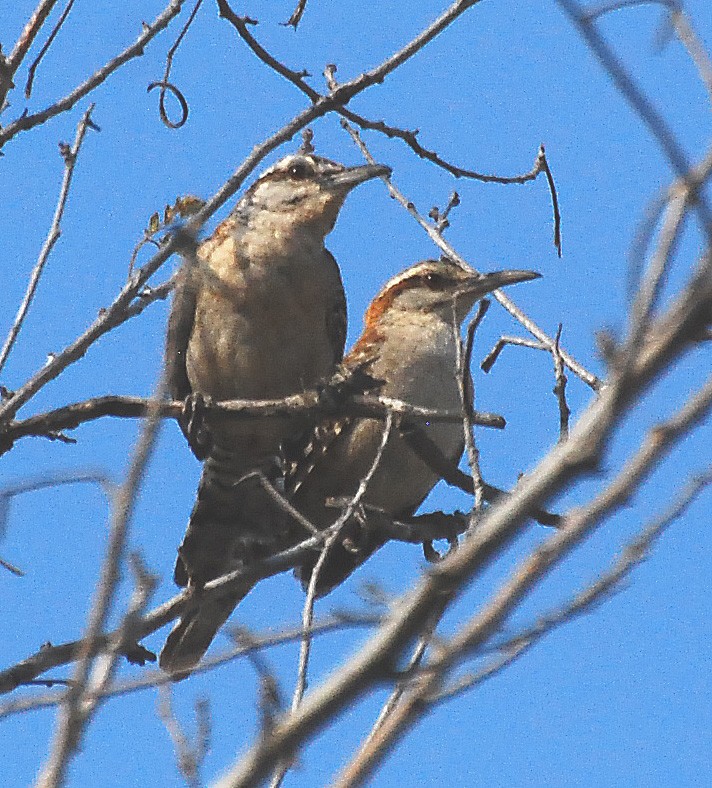
1. Rufous-naped Wren
The Veracruz wren (Campylorhynchus rufinucha) is a songbird of the family Troglodytidae, the wrens. It is a resident breeding species in central Veracruz, Mexico. This species was split from the rufous-naped wren when it was determined three main populations vary markedly in size and coloration, and represented separate species: Veracruz wren (restricted to central coastal Veracruz), Sclater's wren (north and west from western Chiapas), and rufous-backed wren (south and east from western Chiapas). This species sometimes retains the name rufous-naped wren by some taxonomists. Some taxonomic authorities do not recognize the split, including the American Ornithological Society. 
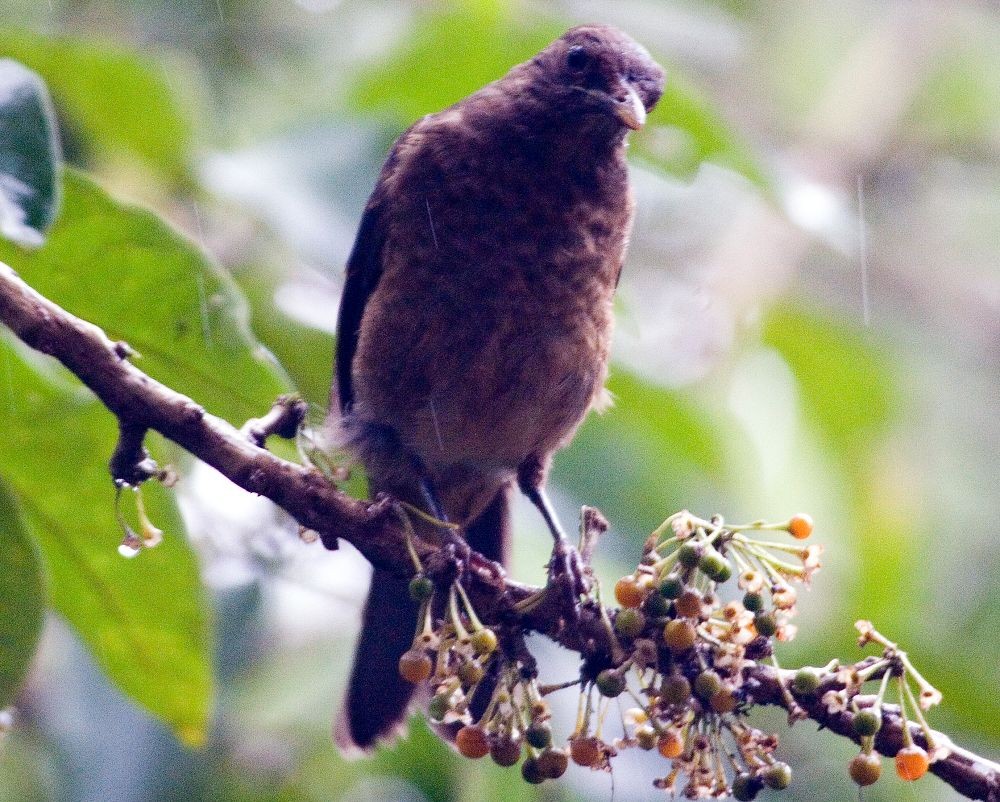
2. Clay-colored Thrush
The clay-colored Thrush is a stunning bird known for its melodious song and distinctive appearance. With its clay-colored upperparts, rusty underparts, and dark brown crown, it stands out in its habitats, which can range from forests to suburban parks. It feeds on various food sources including insects, fruits, and berries. The bird has a melodious song consisting of clear, ringing phrases.
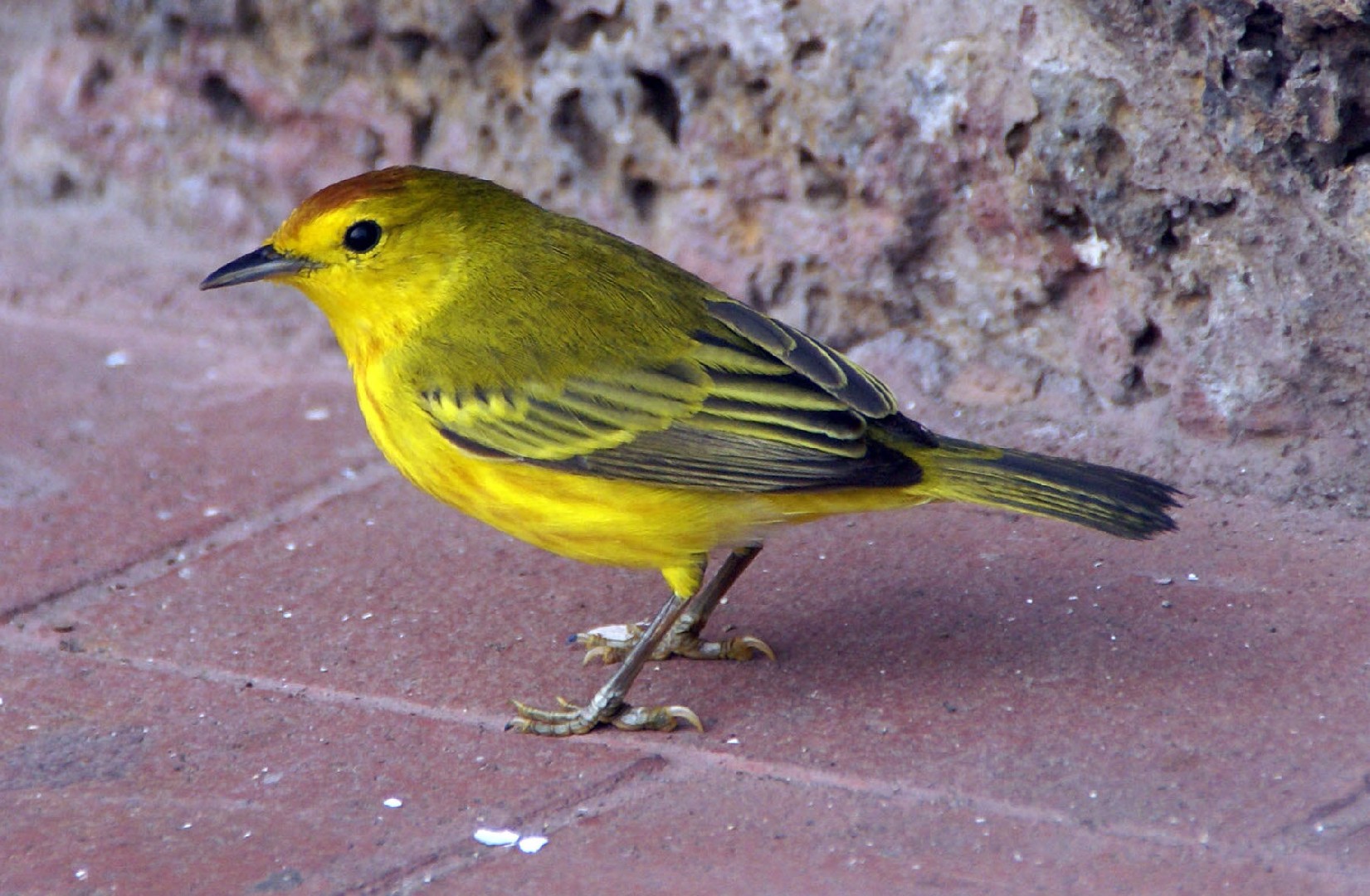
3. Yellow Warbler
Yellow Warblers are small birds that are so tiny they are known to get tangled up in orb-weaver spiders' webs. Their nests are often parasitized by Brown-headed Cowbirds. No worries, says the yellow Warbler, for I'll just rebuild a new nest on top of the one you took from me. This sometimes goes on and on to the point where the nest grows to six tiers high.
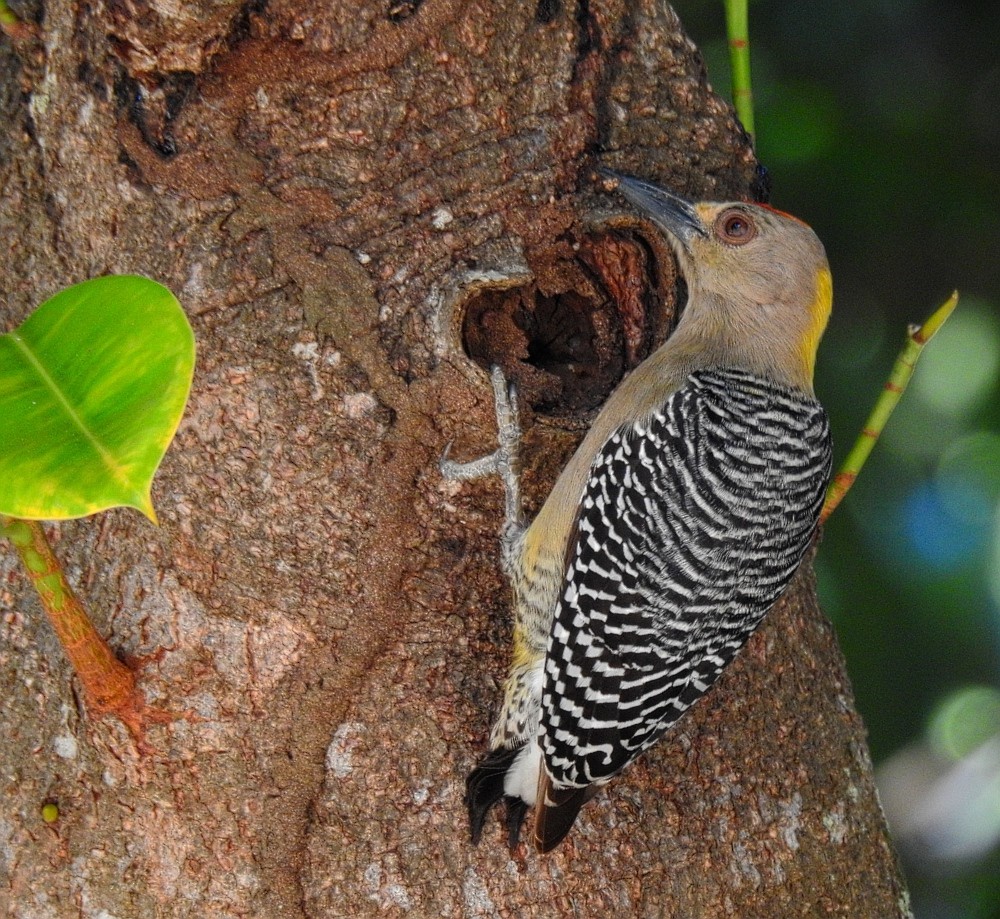
4. Hoffmann's Woodpecker
Hoffmann's woodpecker (Melanerpes hoffmannii) is a resident breeding bird from southern Honduras south to Costa Rica. It is a common species on the Pacific slopes, locally as high as 2,150 m (7,050 ft). It is expanding on the Caribbean slope, aided by deforestation. This is further facilitated by its tendency to wander about outside the breeding season. The adult Hoffmann's woodpecker is 18 cm (7.1 in) long and weighs 68 g (2.4 oz). Its upperparts and wings are neatly barred with black and white, and it has a white rump. The underparts are pale buff-grey with a yellow central belly patch. The male has a white forehead, red crown, and yellow nape. The female has a white crown and forehead and reduced yellow nape. Young birds are duller, have less white above and less yellow on the belly. This common and conspicuous species gives a rattling wicka-wicka-wicka call and both sexes drum on territory. The golden-fronted woodpecker replaces it to the north. It is very similar, but has a yellow forehead; also, the calls are very different. The two species hybridize at the Rio Pespire in Honduras. This woodpecker occurs in deciduous open woodland, second growth, shade trees and hedges, but avoids dense forest. It feeds on insects, often extracted from decaying wood, but will take substantial quantities of fruit and nectar and will mob the ferruginous pygmy owl. It nests in an unlined hole up to 9 m (30 ft) high in a dead tree. The clutch is two or three glossy white eggs, incubated by both sexes. This woodpecker is named for the German naturalist Karl Hoffmann.
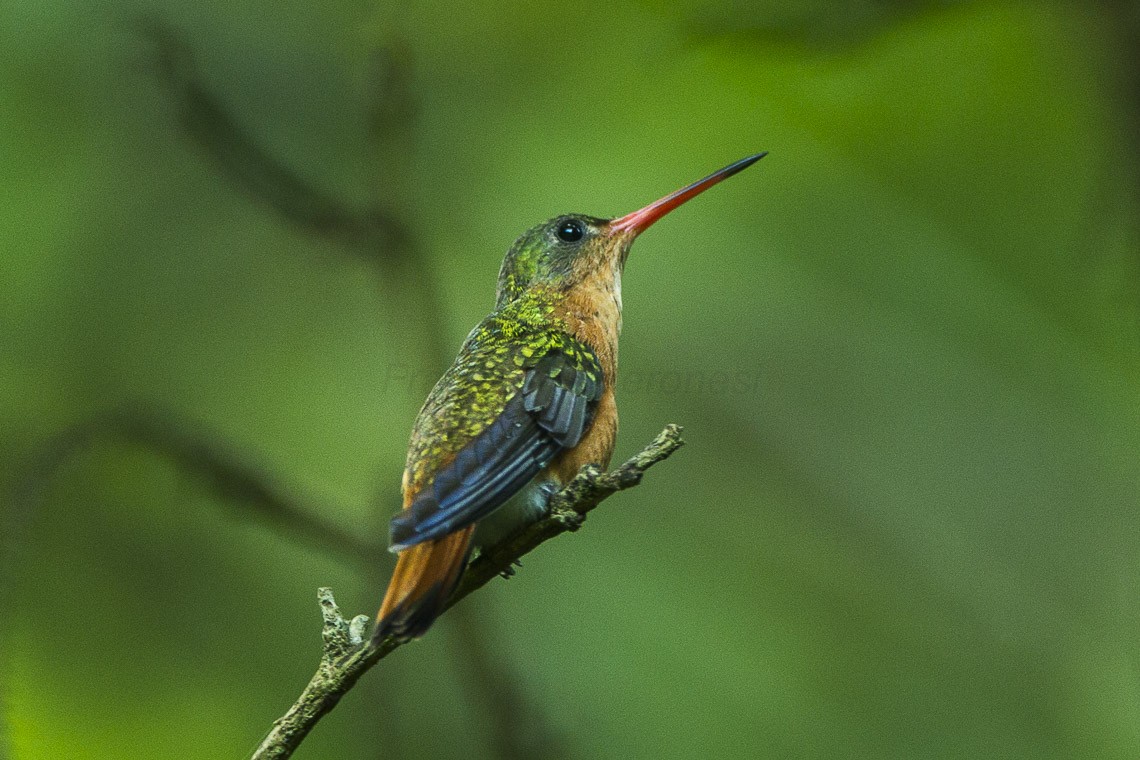
5. Cinnamon Hummingbird
The cinnamon hummingbird (Amazilia rutila) is a species of hummingbird in the family Trochilidae. It is found from northwestern Mexico to Costa Rica. Its natural habitats are subtropical or tropical dry forest, subtropical or tropical moist lowland forest, subtropical or tropical dry shrubland, and heavily degraded former forest. A medium-sized hummingbird, the species measures about 10 cm (3.9 in) and weighs around 5 g (0.18 oz). The upperparts are metallic bronze green while the underparts cinnamon, paler on the chin and upper throat, the wings are dark. Bill is red with a black tip.
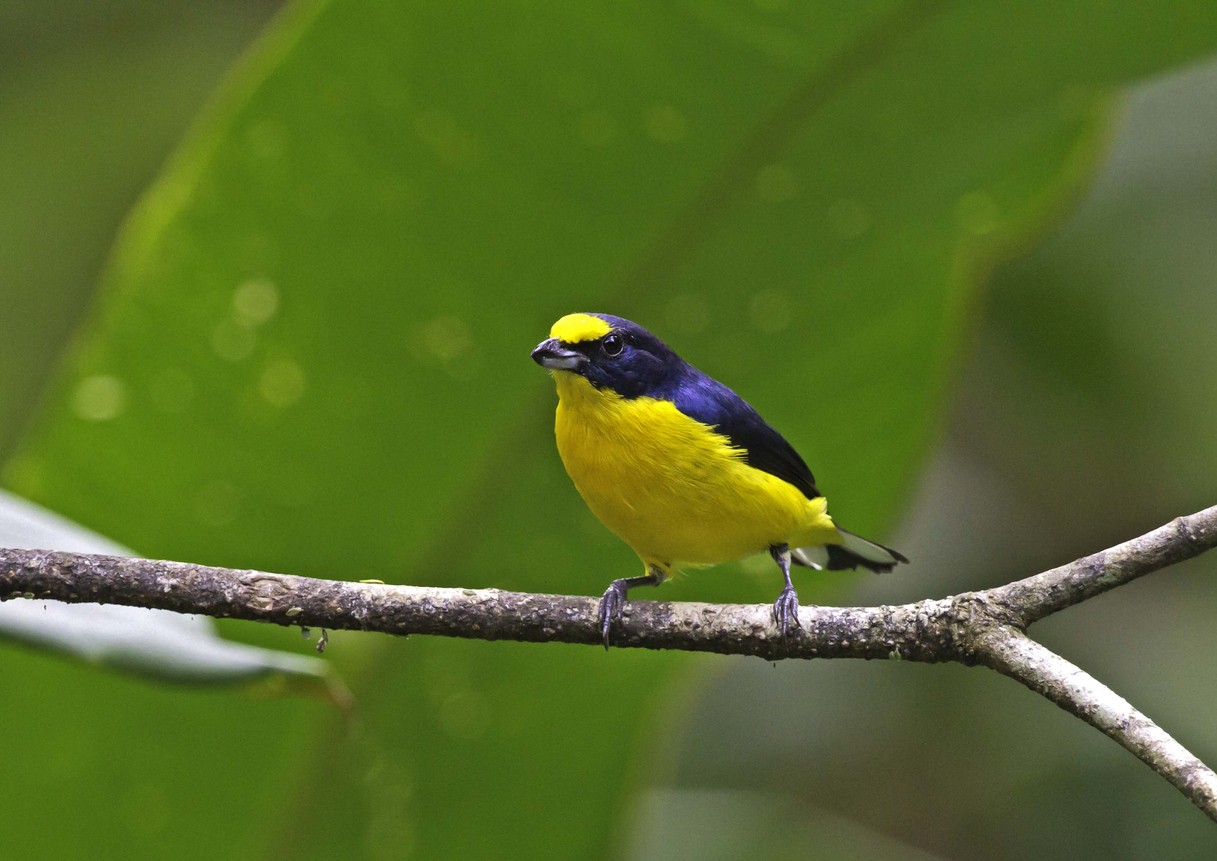
6. Scrub Euphonia
Both sexes have a thin, fine bill, smaller than that of other euphonias. Legs and eyes are dark. The male is bright yellow below and black above, with a small yellow spot on the forecrown. The crissum is white. Females have a grey head, dusky olive upperparts, buff-grey underparts, and white belly and crissum.
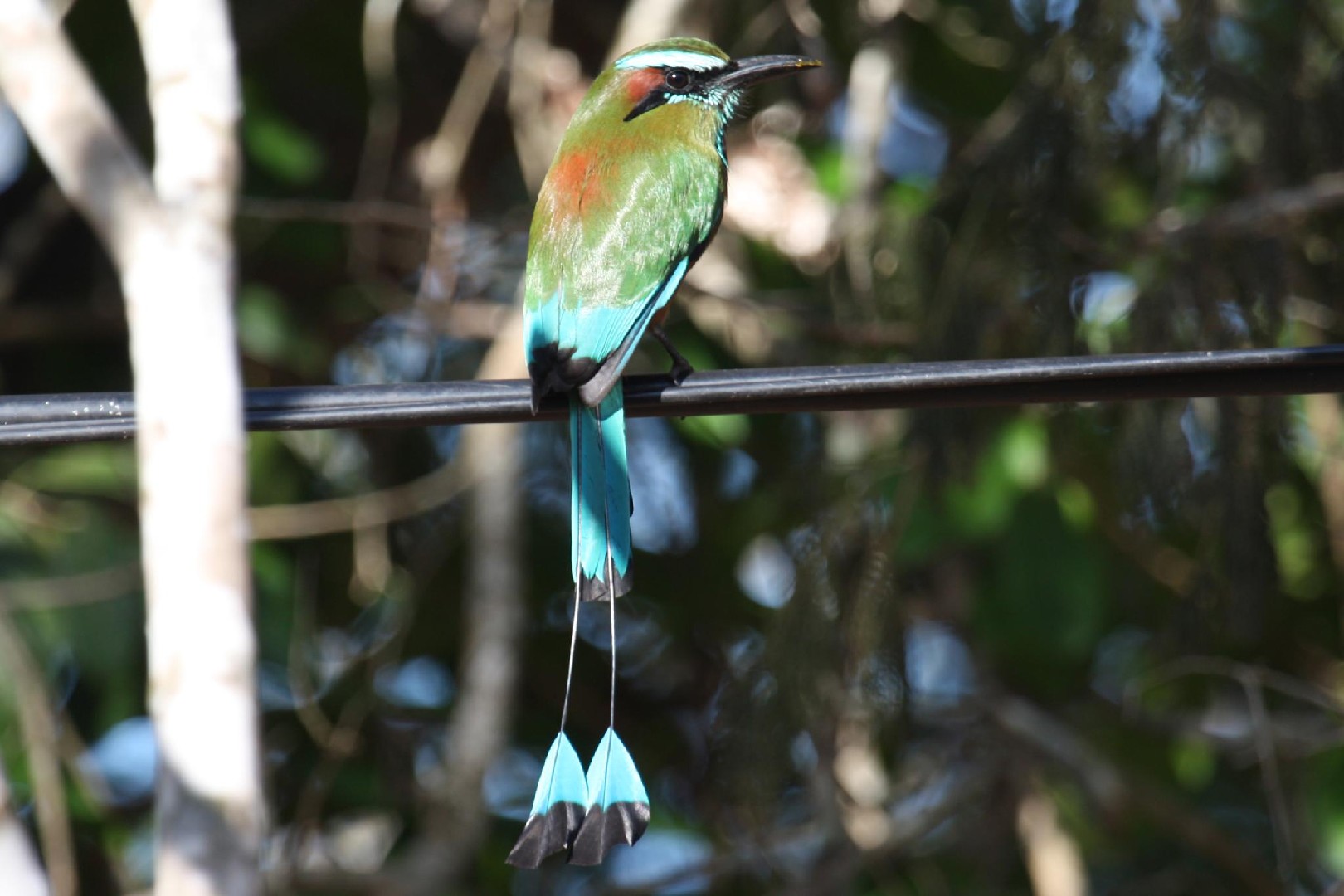
7. Turquoise-browed Motmot
The turquoise-browed motmot (Eumomota superciliosa) also known as Torogoz, is a colourful, medium-sized bird of the motmot family, Momotidae. It inhabits Central America from south-east Mexico (mostly the Yucatán Peninsula), to Costa Rica, where it is common and not considered threatened. It lives in fairly open habitats such as forest edge, gallery forest and scrubland. It is more conspicuous than other motmots, often perching in the open on wires and fences. From these perches it scans for prey, such as insects and small reptiles. White eggs (3–6) are laid in a long tunnel nest in an earth bank or sometimes in a quarry or fresh-water well. Its name originates from the turquoise color of its brow. It was first declared as the official national bird of El Salvador in 1999, where the bird is known as Torogoz. The bird is 34 cm (13 in) long and weighs 65 g (2.3 oz). It has a mostly grey-blue body with a rufous back and belly. There is a bright blue strip above the eye and a blue-bordered black patch on the throat. The flight feathers and upperside of the tail are blue. The tips of the tail feathers are shaped like rackets and the bare feather shafts are longer than in other motmots. Although it is often said that motmots pluck the barbs off their tail to create the racketed shape, this is not true; the barbs are weakly attached and fall off due to abrasion with substrates and with routine preening. Unlike most bird species, where only males express elaborate traits, the turquoise-browed motmot expresses the extraordinary racketed tail in both sexes. Research indicates that the tail has evolved to function differently for the sexes. Males apparently use their tail as a sexual signal, as males with longer tails have greater pairing success and reproductive success. In addition to this function, the tail is used by both sexes in a wag-display, whereby the tail is moved back-and-forth in a pendulous fashion. The wag-display is performed in a context unrelated to mating: both sexes perform the wag-display in the presence of a predator, and the display is thought to confer naturally selected benefits by communicating to the predator that it has been seen and that pursuit will not result in capture. This form of interspecific communication is referred to as a pursuit-deterrent signal. The call is nasal, croaking and far-carrying. The turquoise-browed motmot is a well-known bird in its range and has been chosen as the national bird of both El Salvador and Nicaragua. It has acquired a number of local names including guardabarranco ("ravine-guard") in Nicaragua, Torogoz in El Salvador (based on its call) and pájaro reloj ("clock bird") in the Yucatán, based on its habit of wagging its tail like a pendulum. In Costa Rica it is known as momoto cejiceleste or the far-less flattering pájaro bobo ("foolish bird"), owing to its tendency to allow humans to come very near it without flying away.
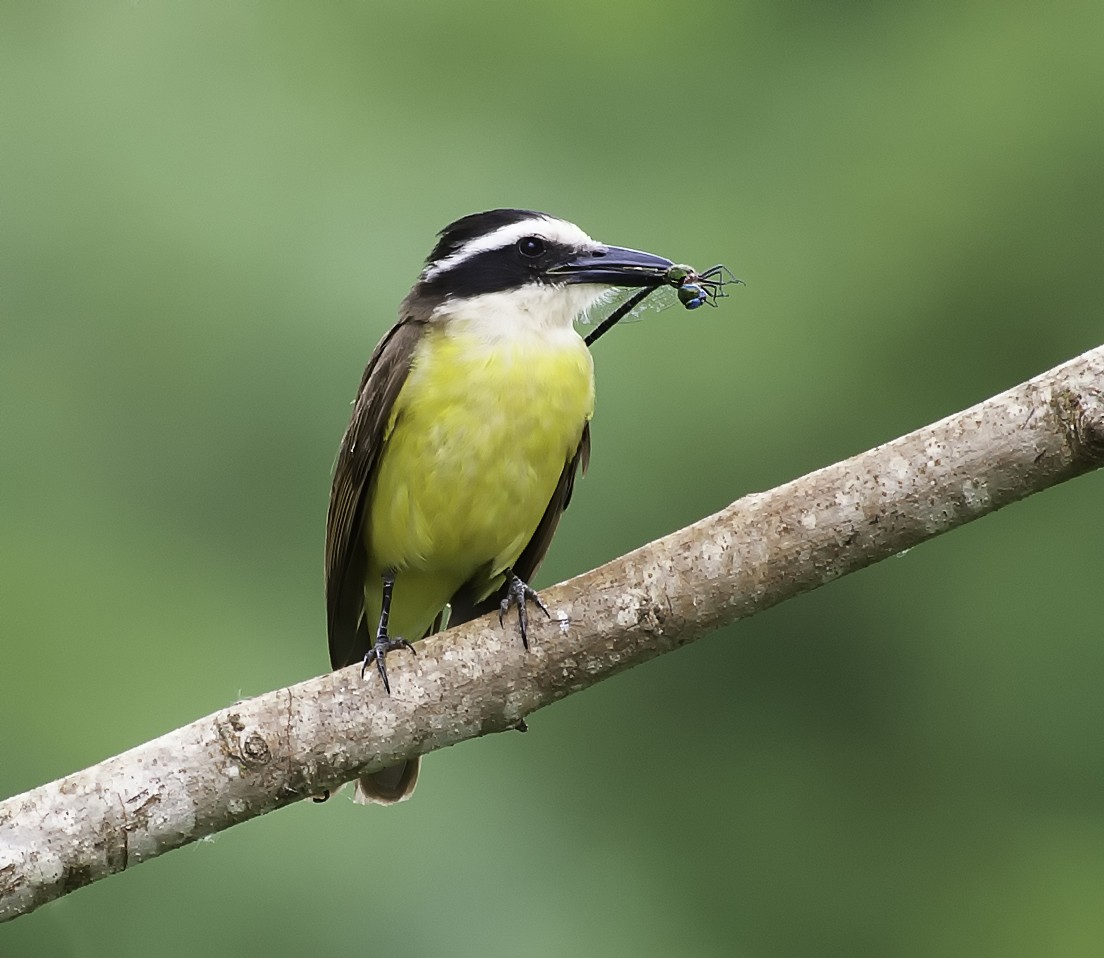
8. Great Kiskadee
The great Kiskadee is a large bird with bold markings that make this flycatcher easily recognizable. is a bright-colored bird that prefers woodland habitats close to water or open areas. It eats a lot of insects, but also forages for seeds and berries and is known to dive into shallow water for small fish.
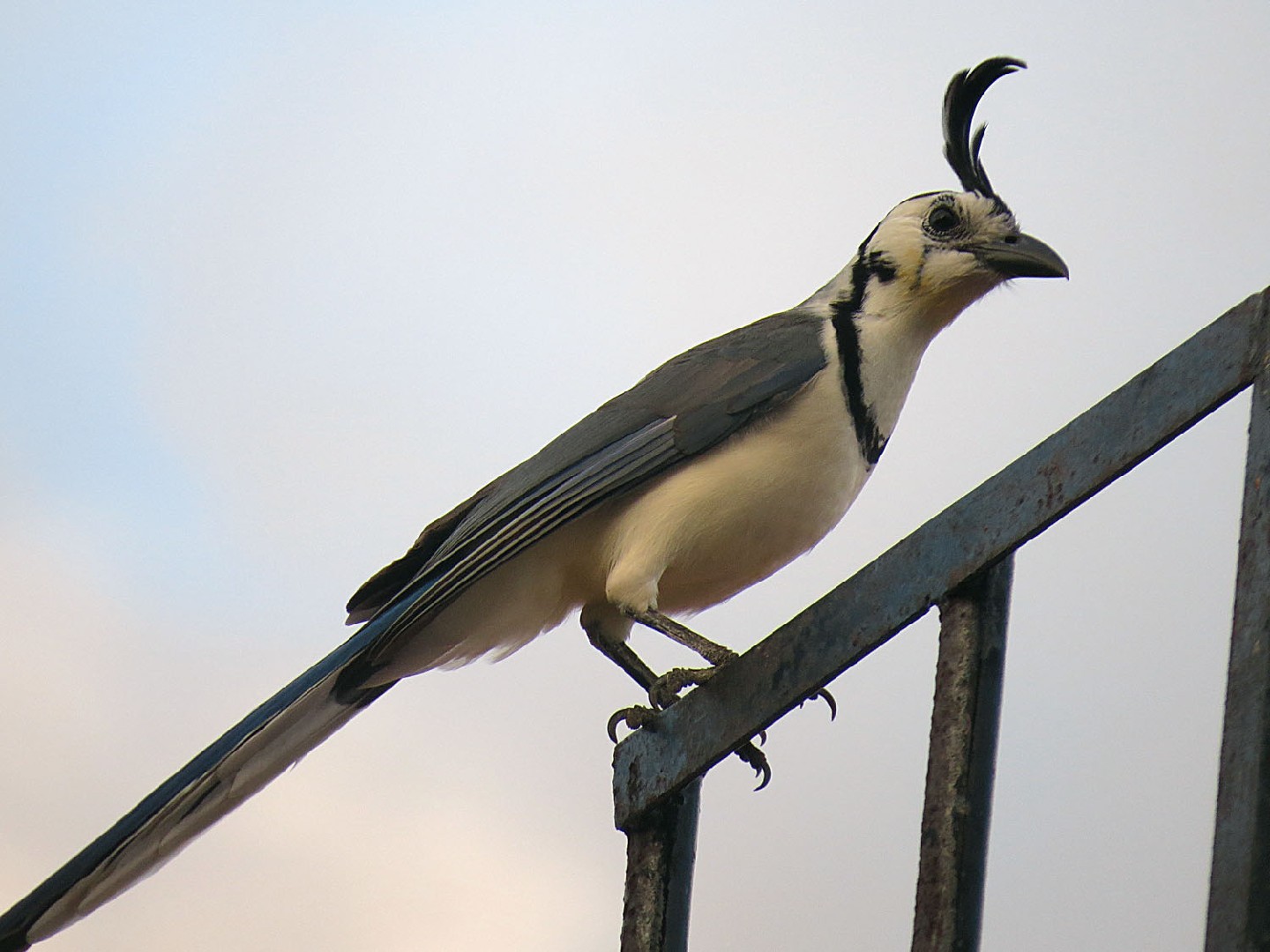
9. White-throated Magpie-jay
The white-throated magpie-jay is between 43 to 56 cm (17–22 in) in length and weighs 205 to 213 g (7.2–7.5 oz). The species has a particularly long tail and a slightly curved crest of feathers on the head. The crest is black in the nominate race, but has blue or white margins on the other two subspecies. The nominate race has a white face with a black crown and margin to the face, forming a narrow band around the throat, as well as a small drop below the eye. The black is less extensive in the other subspecies. The breast, belly and underside of the rump are white, and the wings, mantle and tail are blue (with whitish margins on the tail). The legs and eye are black, and the bill is grey. The plumage of the females is mostly as that of the male but duller on the top, with a narrower band across the chest, and the tail is shorter.
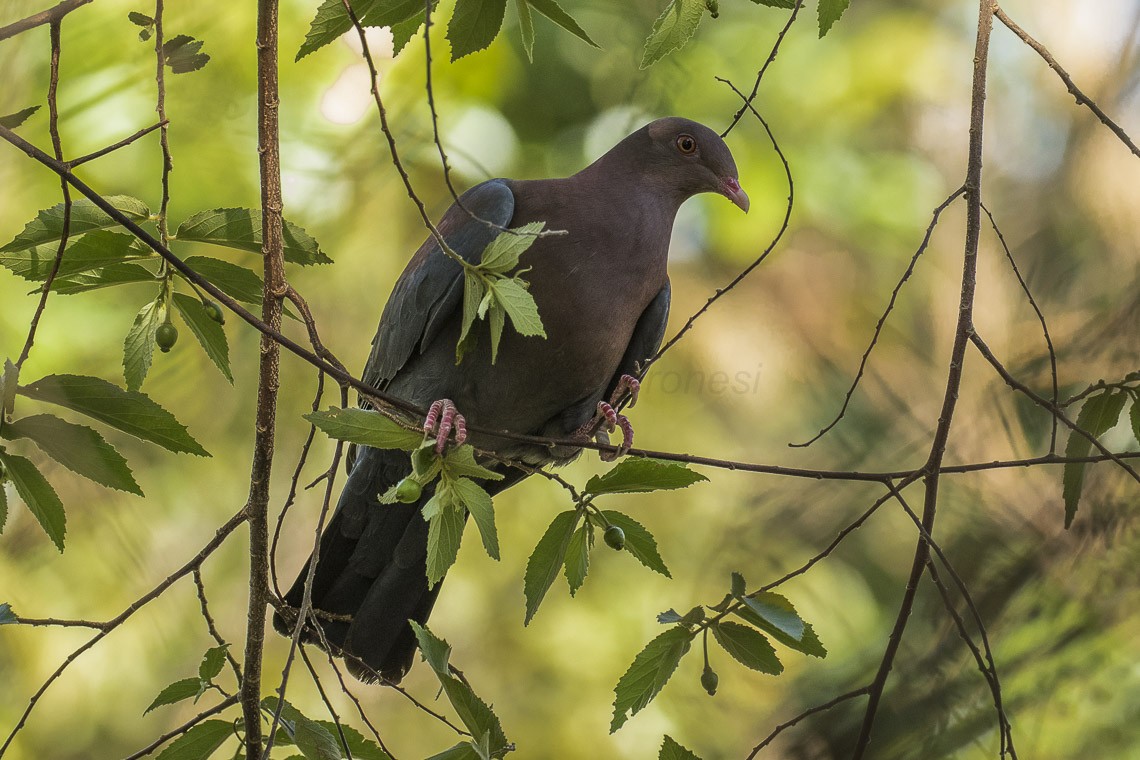
10. Red-billed Pigeon
Red-billed pigeons have largely dark, slate-gray plumage with a more maroon, though sometimes described as purple, head, neck, and wing coverts. They have pale red eyes with an orange orbital ring, along with a red bill with a yellow tip. Noticeably, they don't have iridescent collar plumage. A blue-gray belly and tail coverts, as well as a less brown back, distinguish it from most other species., such as the Ruddy Pigeon and Short-billed Pigeon. The only noticeable difference between males and females is that the females have a duller colored head and neck. Juveniles are often even more dull in color and have dark and dusky shoulders, as well as a more brown mantle and wings. Compared to other birds, they are a more mid-to-large sized bird, growing to be between 30-37 cm (12-15 in.) in length and a weight of 230–425 g (8.1–15.0 oz). Red-billed pigeons have a very distinctive call, described to be a long, high-pitched call consisting of a coooo followed by three cuk-c'-c'-coo notes. It follows an ascending sound. When taking off, the birds' wings create a noticeable clapping noise.
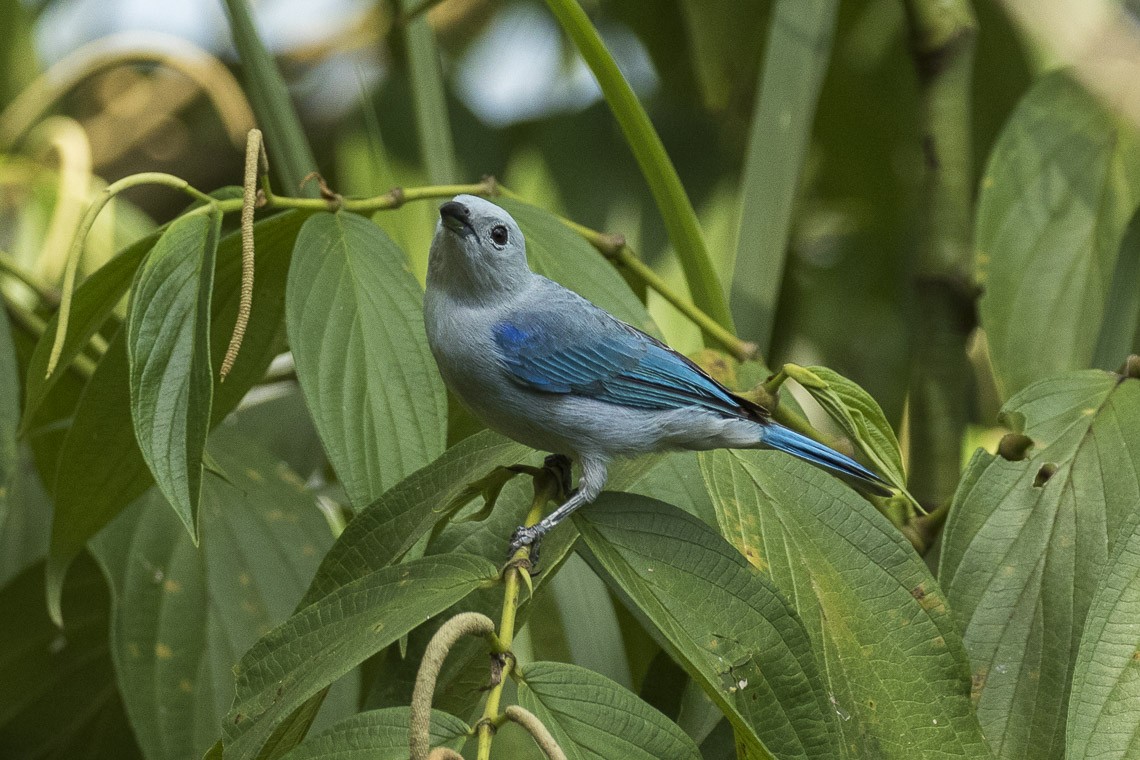
11. Blue-grey Tanager
The blue-gray tanager is 16–18 cm (6.3–7.1 in) long and weighs 30–40 g (1.1–1.4 oz). Adults have a light bluish head and underparts, with darker blue upperparts and a shoulder patch colored a different hue of blue. The bill is short and quite thick. Sexes are similar, but the immature is much duller in plumage. The song is a squeaky twittering, interspersed with tseee and tsuup call notes.
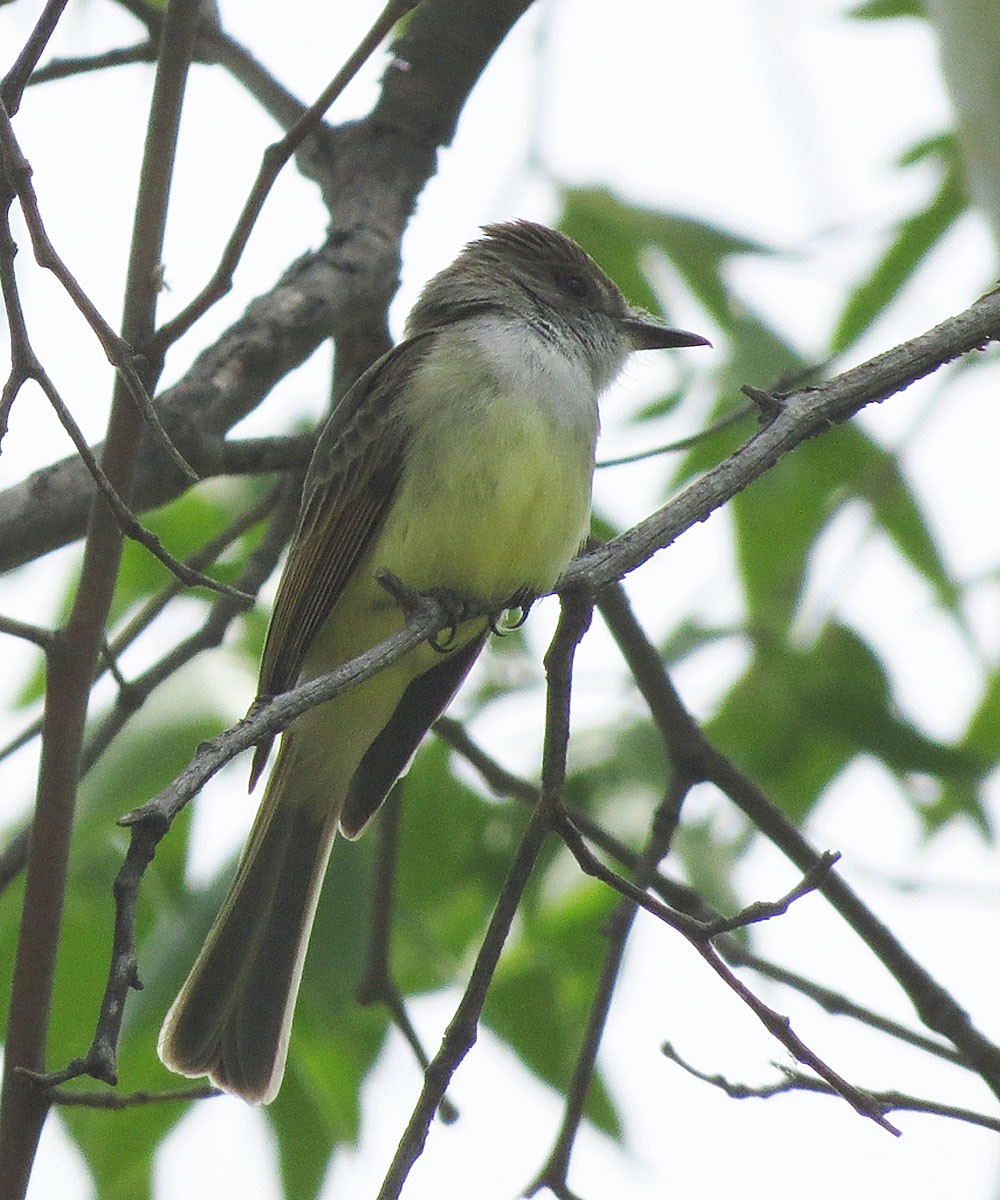
12. Dusky-capped Flycatcher
The dusky-capped flycatcher (Myiarchus tuberculifer) is a passerine bird in the tyrant flycatcher family. It breeds in forest and other woodland from southern Arizona, as well as the Chisos Mountains, Texas, south to northern Argentina and on Trinidad. It is resident in most of its range, but American breeders retreat to Mexico in winter. Adult dusky-capped flycatchers are 18 cm (7.1 in) long and weigh 19.4 g (0.68 oz). The upperparts are brown, with a blackish head and short crest. The breast is grey and the belly is bright yellow. The brown tail feathers and wings have paler outer webs. The sexes are similar, but young birds have rufous edgings to the wings and tail. The dusky-capped flycatcher is best separated from other confusingly similar Myiarchus species by its smaller size, blackish head, and its call, a sorrowful, descending, whistled peeur or wheeeeeu. This species is insectivorous and catches its prey by flycatching amongst the middle branches of trees. Fruits such as from gumbo-limbo (Bursera simaruba), and less frequently from Cymbopetalum mayanum (Annonaceae) are sometimes also eaten, particularly in winter. The nest is built in a tree cavity, and the normal clutch is three brown-marked buff eggs. The young fledge 13 days after hatching.
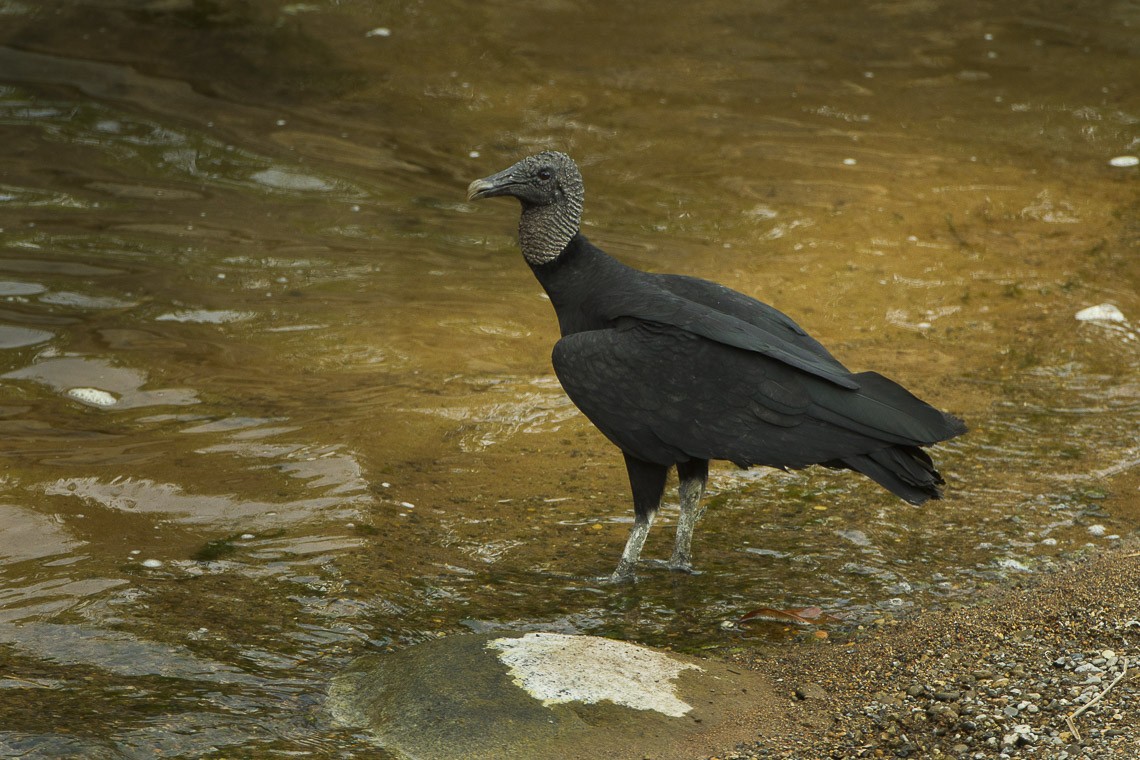
13. Black Vulture
Although quite dapper in appearance, the black Vulture's name comes from the Latin vulturus meaning “tearer" and that is just what that hooked beak is for. These birds are highly social, with fierce family loyalty and will share food with relatives and with their young long after the babies have fledged. Because they lack a voice box, their calls are limited to grunts and hisses.
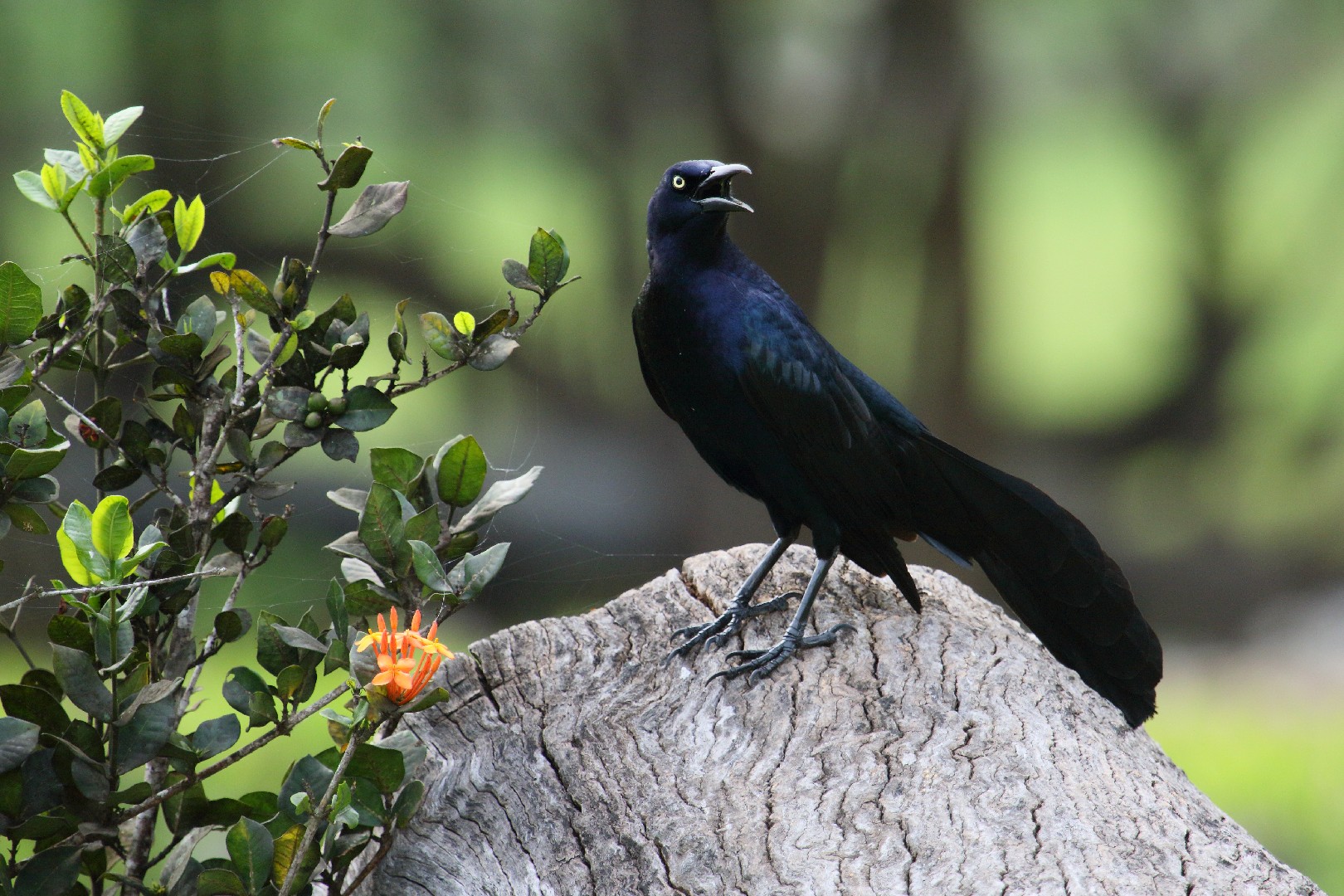
14. Great-tailed Grackle
The medium-sized great-tailed Grackle is notable for its long tail, shaped like a V, and deep black coloring offset by bright yellow eyes. This loud bird can be easily found just by following the sharp sounds of its calls and shrieks. Males in particular shriek and ruffle up their feathers to defend their territory or if they feel threatened.
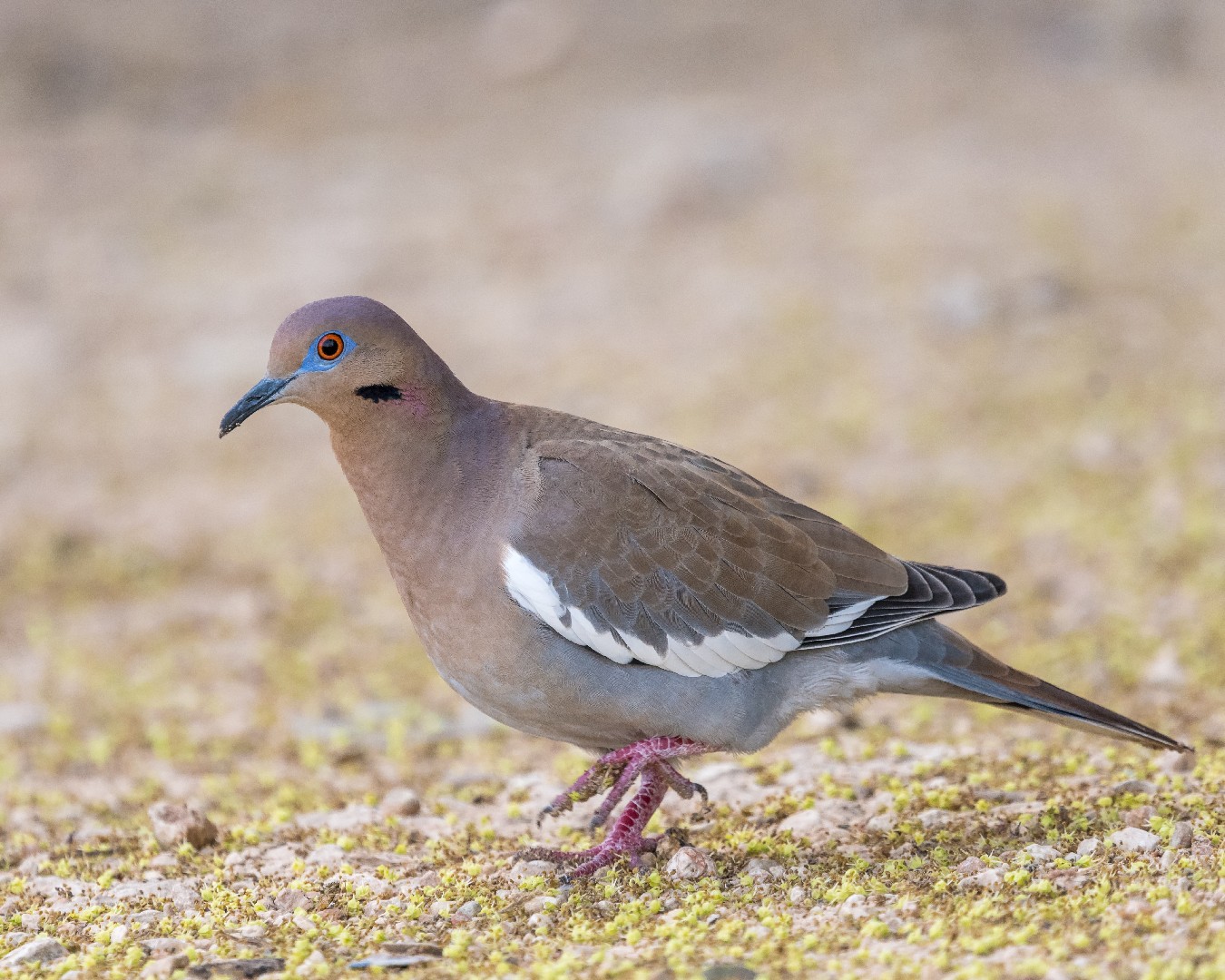
15. White-winged Dove
The medium-sized, distinctively patterned white-winged Doves practically live on Saguaro cactus, consuming its nectar, pollen, fruit, and seeds. In fact, they are so dependent on this plant that they match their migration schedule to its fruiting schedule. White-winged Doves were heavily hunted in Texas in the 20th century and their population dropped from 12 million to fewer than 1 million by 1939. Since then proactive hunting management and the species ability to adapt to urban living has helped their numbers rebound.
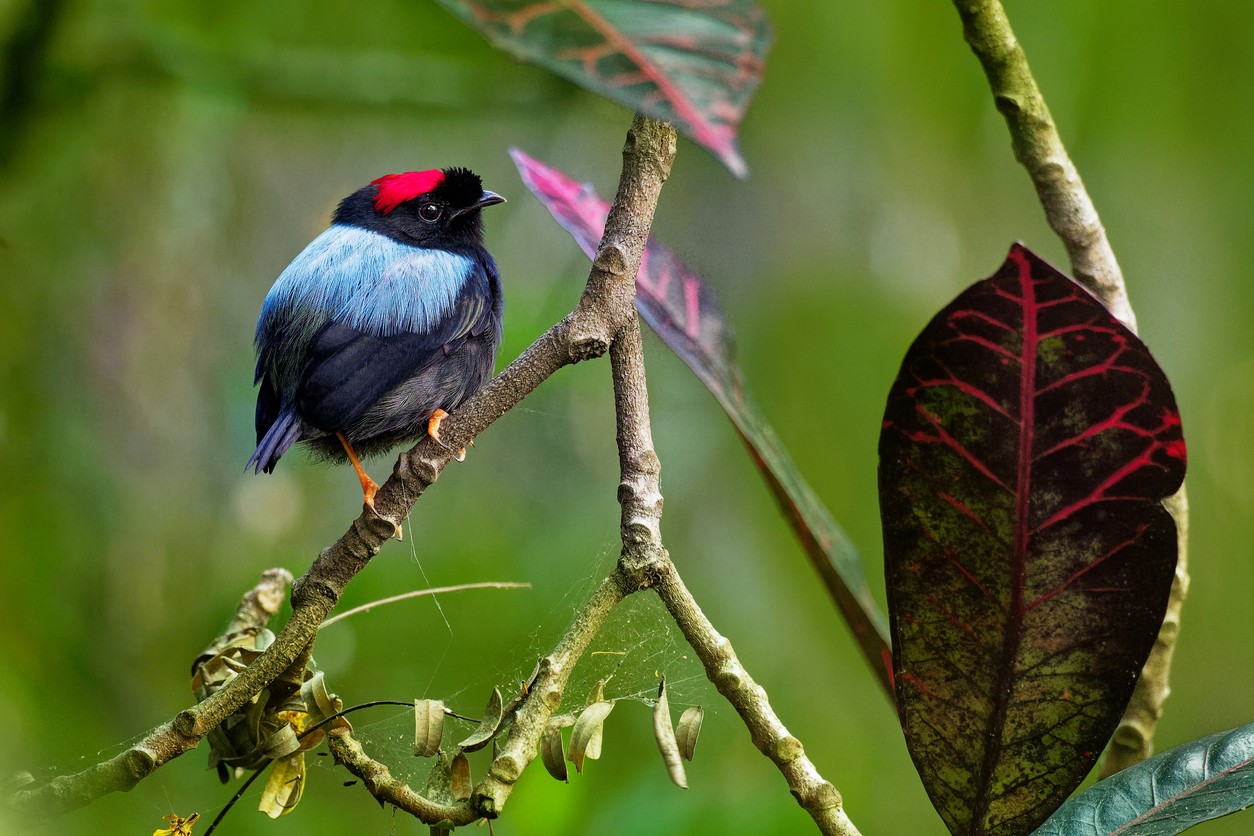
16. Long-tailed Manakin
Large for a manakin, the long-tailed measures about 10 cm (3.9 in) long and weighs 18 g (0.63 oz). The male is mostly a rich black. This is contrasted by a bright red crown and legs. The back is bright blue. The two central tail feathers are narrow and greatly elongated. The female is olive green, paler below and on the chin and throat. Some females have a small amount of red in the crown. It closely resembles the lance-tailed manakin (C. lanceolata), the blue-backed manakin (C. pareola), the swallow-tailed manakin (C. caudata), and the Yungas manakin (C. boliviana), which all have the same red crown and blue back. There is, however, no overlap in range with these four species.
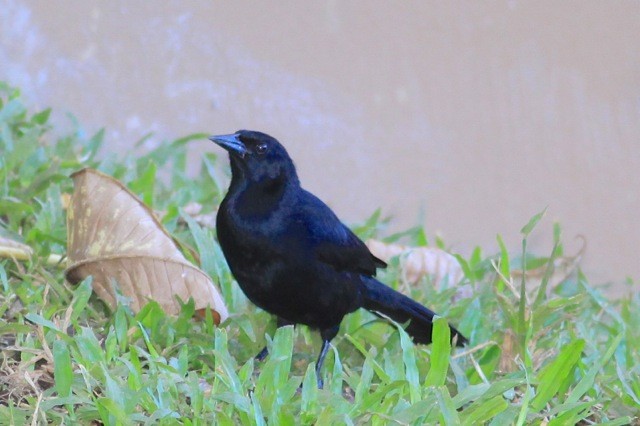
17. Melodious Blackbird
The adult is a medium-sized blackbird with a rounded tail. The male is 25.5 cm (10.0 in) long and weighs 108 g (3.8 oz). The slightly smaller female is 23 cm (9.1 in) long and weighs 95 g (3.4 oz). The adult plumage is entirely black with a bluish gloss, and the bill, legs and feet are also black. The iris is brown. Females are identically plumaged to the males; young birds are brownish black and lack iridescence. There are no subspecies.
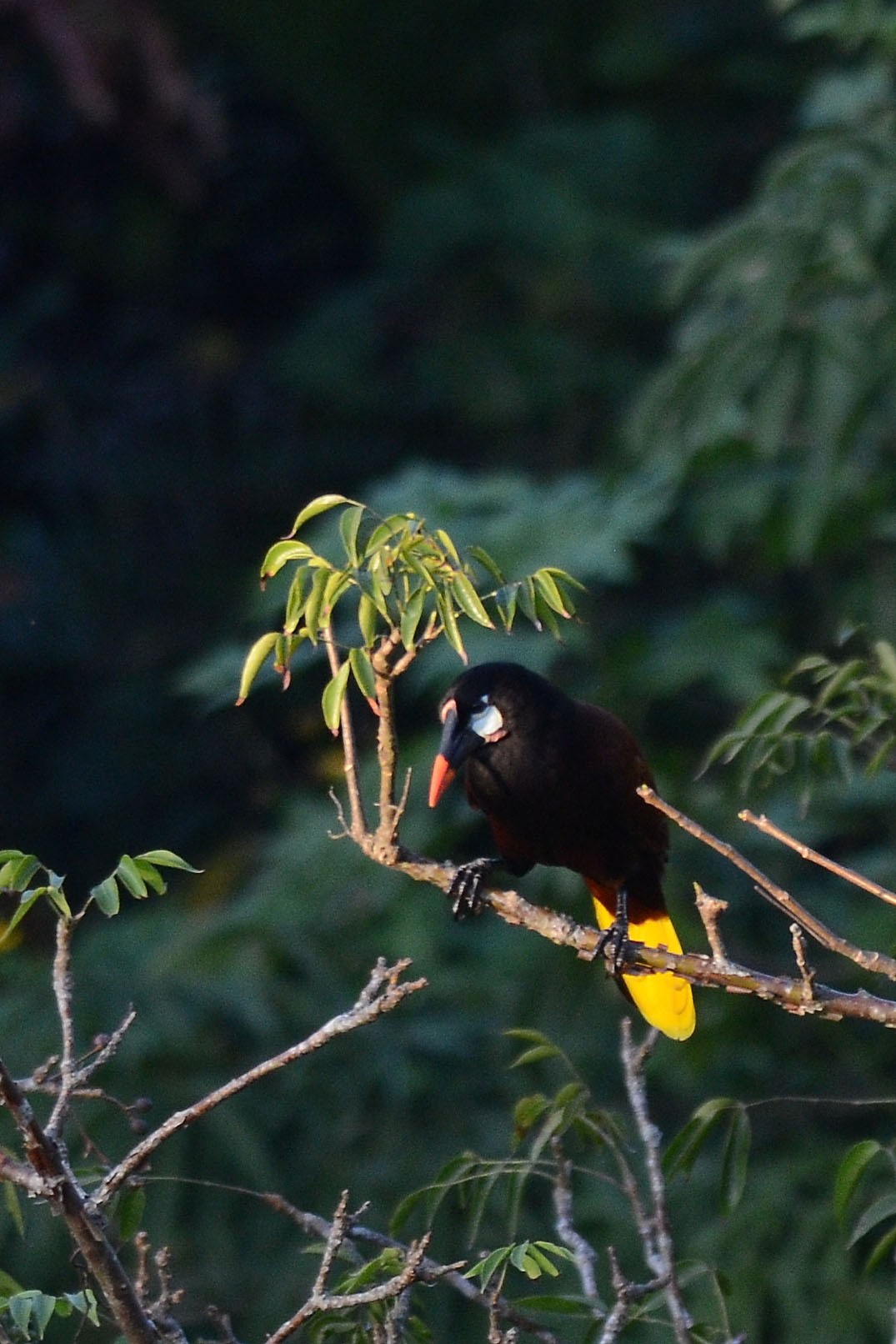
18. Montezuma Oropendola
The Montezuma Oropendola (Psarocolius montezuma) is a New World tropical icterid bird. It is a resident breeder in the Caribbean coastal lowlands from southeastern Mexico to central Panama, but is absent from El Salvador and southern Guatemala. It also occurs on the Pacific slope of Nicaragua and Honduras and northwestern Costa Rica. It is among the oropendola species sometimes separated in the genus Gymnostinops. The English and scientific names of this species commemorate the Aztec emperor Moctezuma II. The sexes are very different in size; the male is 50 cm (20 in) long and weighs 520 g (18 oz); the smaller female is 38 cm (15 in) long and weighs 230 g (8.1 oz). In total body mass, the males are 100% bigger than the females, which is a 2:1 body-to-mass ratio and makes the Montezuma oropendola one of the most sexually-dimorphic birds in the world. Webster et al. says that the size difference in males and females is probably directly related to differences in foraging habits. The females often forage on thin branches, eating insects out of curled up leaves, while the males often perch on thick branches and forage in epiphytes and bromeliads. Webster et al. also found that sexual dimorphism was more obvious in length of the wing and body mass. Male size and body mass is associated with sexual fitness and dominance. Webster et al. observed that males defend sexually-receptive females, suggesting that Montezuma oropendolas have a female-defence mating system. While the females nest, the males fight and fend off one another, and the males were ranked depending on the outcome of each fight. The alpha male eventually pushes out all other males until he is the only one left. When the alpha males leave the others come back and defend females until he returns. This type of mating system is similar to that of polygynous mammals, not birds. Adult males are mainly chestnut with a blackish head and rump, and a tail which is bright yellow apart from two dark central feathers. There is a bare blue cheek patch and a pink wattle, the iris is brown, and the long bill is black at the base with a red tip. Females are similar, but smaller than males with a smaller wattle. Young birds are duller than adults and have a paler and less demarcated bill. No subspecies are currently recognized. The "unforgettable" song of the male Montezuma oropendola is given during the bowing display, and consists of a conversational bubbling followed by loud gurgles, tic-tic-glik-glak-GLUUuuuuu. Both sexes have loud cack and crrrk calls. In a recent study by on male Montezuma oropendolas, researchers found that, when at breeding sites, males often changed the lowest peak frequency. When males were singing and their song overlapped, the largest male could out-compete the other males at the colony by changing how loud and how deep his lowest peak frequency was. Although the chestnut-headed oropendola shares much of this species's range, it is smaller, mainly black with a chestnut head (instead of mainly chestnut with a blackish head), and lacks coloured facial patches, so the two oropendolas are unlikely to be confused. The Montezuma oropendola is a quite common bird in parts of its range. They are omnivorous and are often seen in small or larger flocks foraging in trees for small vertebrates, large insects, nectar, and fruit, including bananas, Cecropia spikes, gumbo-limbo (Bursera simaruba) and Trophis racemosa (Moraceae). Outside the breeding season, this species is quite mobile, with some seasonal movements. The Montezuma oropendola inhabits forest canopy, edges and old plantations. It is a colonial breeder and only the females build hanging woven nest of fibres and vines, 60–180 cm (24–71 in) long, in a tree that is up to 30 meters high. Each colony has a dominant male, which mates with most of the females following an elaborate bowing display. The female lays two dark-spotted white or buff eggs, and she incubates them without the male until they hatch in 15 days; the young fledge in 30. While the young are still in their nests they are most often fed spiders and other arthropods, frogs, lizards, and fruits. There are typically about 30 nests in a colony, but up to 172 have been recorded. Unlike some populations of its relative, the chestnut-headed oropendola, the Montezuma oropendola does not tolerate brood parasites near their nests. Although Montezuma oropendolas do not have many defenses against Cowbirds, when females see a Giant Cowbird near their own nest they actively defend their nest by attacking the Cowbirds and forcing them to leave their colony. Webster et al. found that the females did not drive the cowbirds away until they were approaching their own nests. This study also found that unlike chestnut-headed oropendolas, the Montezuma oropendolas did not nest near social Hymenoptera. Combined with the fact that Montezuma oropendolas do not allow Cowbirds near their nest, they have no defense against botflies. Nest success is fairly low for the Montezuma Oropendola. The females lay an average of two eggs per nest, but only one is fledged and only one third of the nests in the colonies are successful. Because of their relatively low nest success rate, brood parasites are too high of a risk to have around the Montezuma oropendolas nest.
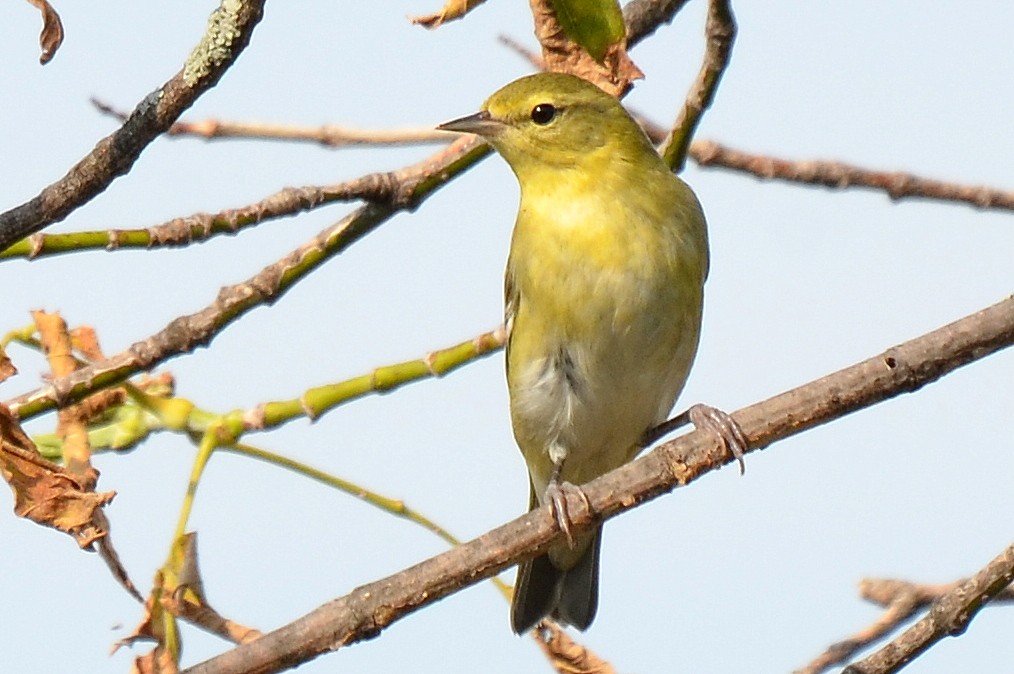
19. Tennessee Warbler
The Tennessee warbler is 11.5 cm (4.5 in) long, has a 19.69 cm (7.75 in) wingspan, and weighs roughly 10 g (0.35 oz). The breeding male has olive back, shoulders, rump and vent. The flight feathers are brownish-black. It has a slate gray neck, crown and eyeline. The underside is a gray-white. The female is similar to the male, but is much duller and has a greener tinge to the underside. The Tennessee warbler has long wings, short tail and a thin, pointy bill. Juveniles and first-year birds are quite similar to the female. Tennessee warblers resemble female black-throated blue warblers. The only difference is that the black-throated blue has a darker cheek and two white wing spots. This bird can be confused with the red-eyed vireo, which is larger, moves more deliberately and sings almost constantly. The orange-crowned warbler can also look similar, but lacks the white eyebrow, is greyer-brown above and has yellow undertail coverts.
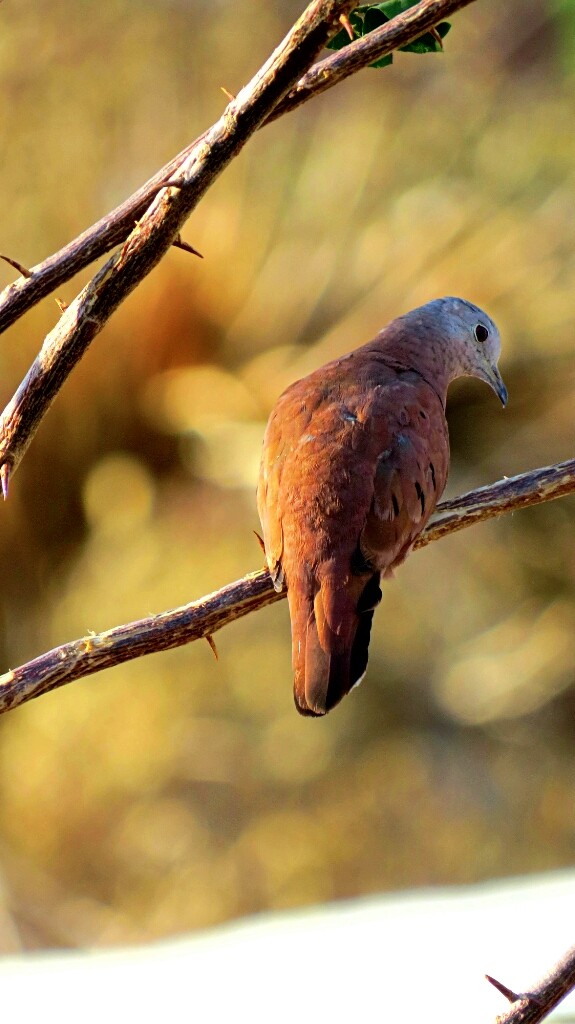
20. Ruddy Ground Dove
The Rosttäubchen (Columbina talpacoti) is a kind of the pigeons birds, which is counted among the subfamily of the American Kleintauben. The species occurs from the extreme south of North America to South America and is considered as not endangered in its population.