


Nilgiri Flowerpecker
A species of Typical Flowerpeckers Scientific name : Dicaeum concolor Genus : Typical Flowerpeckers
Nilgiri Flowerpecker, A species of Typical Flowerpeckers
Botanical name: Dicaeum concolor
Genus: Typical Flowerpeckers
Content
Description General Info
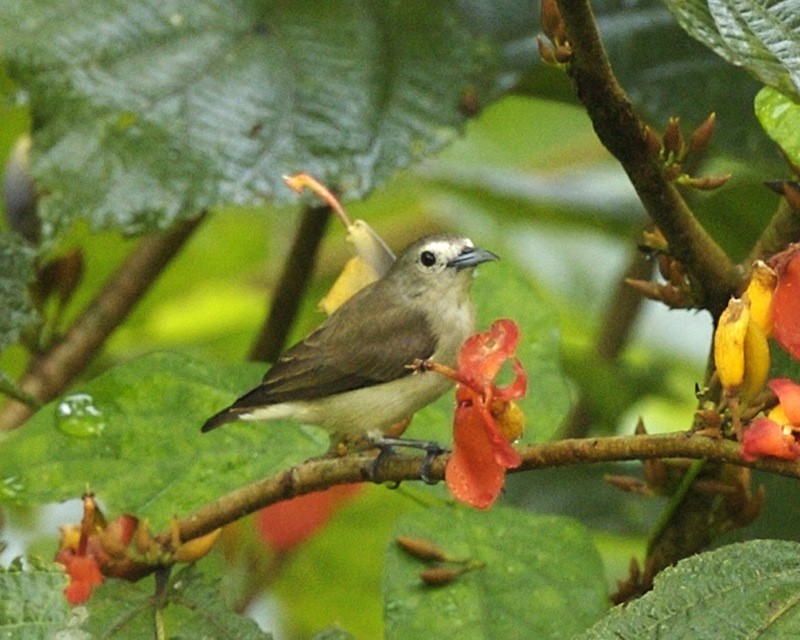 Photo By Lip Kee Yap , used under CC-BY-SA-2.0 /Cropped and compressed from original
Description

These birds are tiny (9 cm long) and there is no marked difference between the males and females. It is found in hill forests of the Western Ghats and Nilgiri hills of southern India. It is pale brown on the upperside and the underside is whitish. The whitish brow in front of the eye is wider than in Dicaeum erythrorhynchos. This subspecies has been raised to full species by Pamela Rasmussen. The subspecies found in northeastern India, extending into Myanmar, Laos and southern China is called olivaceum by earlier authors but is treated by Rasmussen and other taxonomists now as a separate species Dicaeum minullum (which includes the population minullum from Hainan Island and is now termed as the plain flowerpecker in the more restricted sense). This is very olive above and the black bill is finer and slightly curved. The population found in the Andaman Islands virescens is also considered a separate species Dicaeum virescens (the Andaman flowerpecker) in the newer treatment. This is bright olive-green on the upperside with dark speckling on the crown. The centre of the belly has a bright patch of pale yellow. 
Size
9 cm
Nest Placement
Tree
Feeding Habits
Nilgiri Flowerpecker predominantly feeds on nectar, favoring mistletoe species like Taxillus cuneatus and Dendrophthoe neelgherrensis. It forages across various strata, typically 4–6 m above ground, exclusively at flowers.
Habitat
The nilgiri Flowerpecker predominantly inhabits evergreen and moist deciduous forests, typically found in hilly regions. It thrives in environments that include forest edges, as well as in groves and various types of tree plantations, suggesting a preference for areas with abundant foliage and diverse plant life.
Dite type
Frugivorous

General Info
Feeding Habits
Bird food type
Fruit
Behavior
The Nilgiri flowerpecker is a common resident breeding bird of woodland edges, cultivation and isolated stands of trees, often in hilly country. The call of the Nilgiri flowerpecker is a sharp check or a rapid series of ticks, while the song is a high-pitched trill. The breeding season of concolor in the Nilgiris is January to April possibly with a second brood in May and June. Two or three eggs are laid in a purse-like nest suspended from a tree or bush. Like other flowerpeckers they have a feathery tongue that allows them to sip nectar, but they feed on soft berries as well as small insects. They are important pollinators and dispersers of mistletoes in tropical forests.
Species Status
Not globally threatened.


Scientific Classification
Phylum
Chordates Class
Birds Order
Perching birds Family
Flowerpeckers Genus
Typical Flowerpeckers Species
Nilgiri Flowerpecker 
Download Picture Bird
Identify any bird by photo or sound in seconds
Identify any bird by photo or sound in seconds