


Black-sided Flowerpecker
A species of Typical Flowerpeckers Scientific name : Dicaeum monticolum Genus : Typical Flowerpeckers
Black-sided Flowerpecker, A species of Typical Flowerpeckers
Botanical name: Dicaeum monticolum
Genus: Typical Flowerpeckers
Content
Description General Info
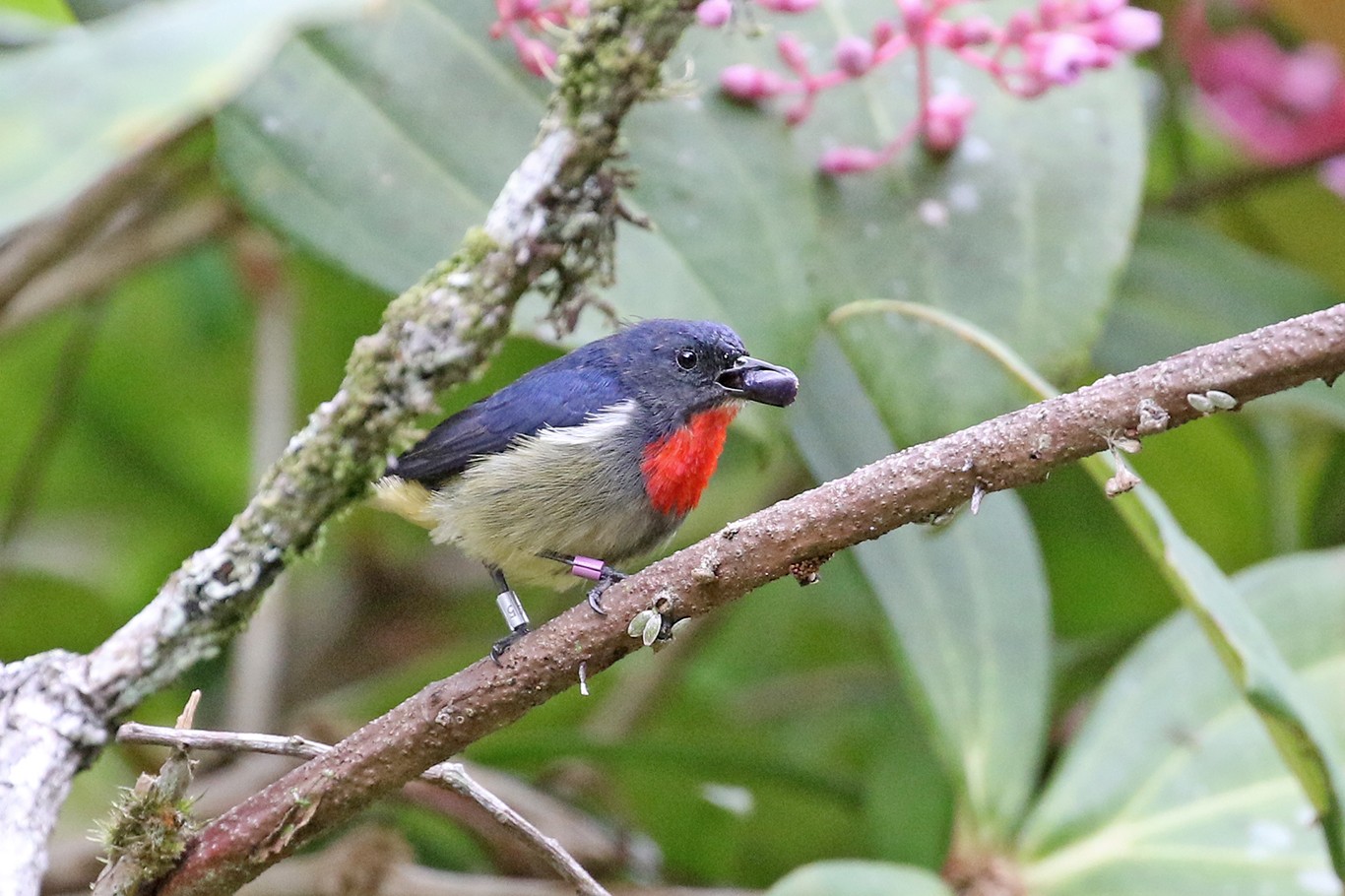 Photo By Charley Hesse TROPICAL BIRDING
Description

The black-sided flowerpecker is a very small passerine, measuring a mere 8 cm (3.1 in) in length. Its weight has not been recorded. Like many flowerpeckers, it is sexually dimorphic; the male is considerably more colourful than the female. The male has glossy blue-black upperparts. His face and the sides of his neck are black, his chin is white, and he has a scarlet throat and breast surrounded by a greyish-black border. His upper flanks and upper belly are dark grey, while his lower flanks are olive, and his lower belly white. His vent and undertail coverts are buffy-yellow. His underwing coverts are white, as are his pectoral tufts. The female has olive-green upperparts and greyish underparts, with buffy flanks, a yellowish rump, a whitish throat and white pectoral tufts. Immature birds are like the female, but more olive-grey below. They are finely streaked with dark from their chin to the breast, and males may show some crimson on the breast. Both sexes have dark brown irises, black bills, and feet variously described as brown or dark grey. 
Size
8 cm
Nest Placement
Tree
Feeding Habits
Black-sided Flowerpecker primarily consumes mistletoe berries from the Loranthaceae family, Medinilla speciosa berries, small fruits, seeds, nectar, and invertebrates. It forages for food near the ground and occasionally in the canopy.
Habitat
The black-sided Flowerpecker frequents montane and hill dipterocarp forests, as well as heath forests, extending to scrublands and gardens within these environments. Typically found at elevations ranging from 460 to 2540 meters, these birds are most common in montane regions. They inhabit both primary and secondary forests, including specialized habitats like kerangas (heathland) forests, across broader montane areas.
Dite type
Frugivorous

General Info
Feeding Habits
Bird food type
Fruit
Species Status
The International Union for Conservation of Nature rates the black-sided flowerpecker as a species of least concern, though its population has not been quantified. While its numbers are thought to be decreasing, the rate of decline is not thought to be precipitous, and the population is not fragmented. The species is said to be common throughout much of its range. Destruction of forest for oil palm plantations could have a detrimental impact on their numbers. Studies have shown that black-sided flowerpeckers are only found in palm groves in small numbers and within 300 m (980 ft) of the edge of forest; they were not found further into extensive groves.
 Photo By Charley Hesse TROPICAL BIRDING
Scientific Classification
Phylum
Chordates Class
Birds Order
Perching birds Family
Flowerpeckers Genus
Typical Flowerpeckers Species
Black-sided Flowerpecker 
Download Picture Bird
Identify any bird by photo or sound in seconds
Identify any bird by photo or sound in seconds