


Grey-crested Finch
A species of Black-crested and Grey-crested Finches Scientific name : Lophospingus griseocristatus Genus : Black-crested and Grey-crested Finches
Grey-crested Finch, A species of Black-crested and Grey-crested Finches
Botanical name: Lophospingus griseocristatus
Genus: Black-crested and Grey-crested Finches
Content
Description General Info
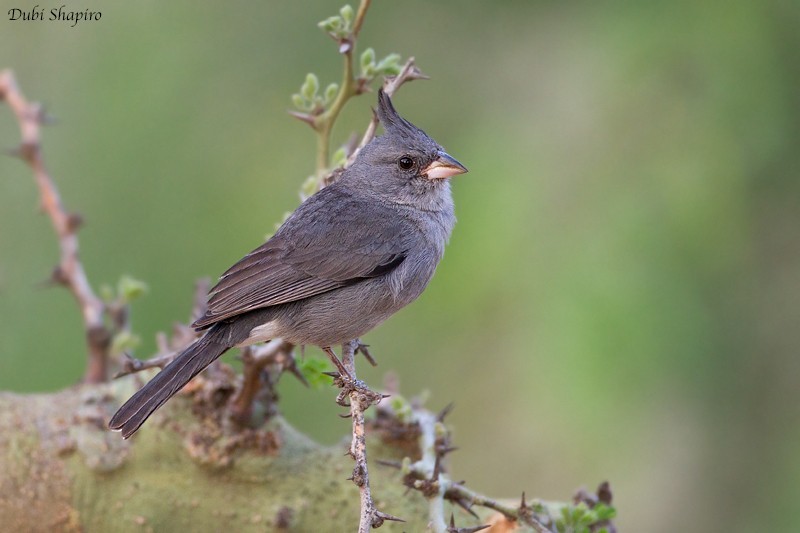 Photo By Dubi Shapiro
Description

The grey-crested finch has a distinctive erect, spiky grey crest. Other parts of the bird are grey also, with the underparts being paler than the upper parts, and the belly being whitish. The wings and tail are deeper grey, except for the outer corners of the tail which are white and particularly noticeable in flight. The beak is yellow, pink and grey. The adult length of this finch is about 14 cm (5.5 in). 
Size
14 cm
Nest Placement
Shrub
Habitat
Grey-crested Finch typically inhabits arid montane scrub environments, which include secondary growth scrub, arid hillside scrub, and weedy edges of agricultural fields. These habitats are characterized by dry, desert and xeric conditions, predominantly found in intermontane valleys with dry, thorny scrub such as cactus and Prosopis species. Grey-crested Finch is sometimes located near human habitation, and bare earth areas may also be utilized within its habitat preferences.
Dite type
Granivorous

General Info
Feeding Habits
Bird food type
Distribution Area
The grey-crested finch is native to South America. Its range includes the Andean foothills of western Bolivia and northwestern Argentina, where it occurs at altitudes of between 1,500 and 3,100 m (4,900 and 10,200 ft). It typically occurs in arid habitats, in dry scrubland with tall cacti, dry valleys in the mountains, and on the fringes of agricultural land. It is common in Bolivia but less so in Argentina.
Species Status
The grey-crested finch has a wide range and is a common species. Although the population size has not been estimated, its trend seems to be stable, and the International Union for Conservation of Nature has assessed the bird's conservation status as being of "least concern".
 Photo By Dubi Shapiro
Scientific Classification

Download Picture Bird
Identify any bird by photo or sound in seconds
Identify any bird by photo or sound in seconds