


Bearded Mountaineer
A species of Bearded Mountaineer Scientific name : Oreonympha nobilis Genus : Bearded Mountaineer
Bearded Mountaineer, A species of Bearded Mountaineer
Botanical name: Oreonympha nobilis
Genus: Bearded Mountaineer
Content
Description General Info
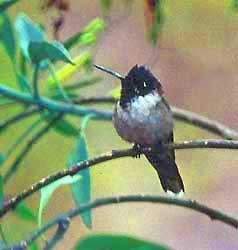 Photo By Don Roberson
Description

The bearded mountaineer (Oreonympha nobilis) is a species of hummingbird in the family Trochilidae. It is found only in Peru. Its natural habitat is subtropical or tropical high-altitude shrubland. The ornithologist John Gould described the species in 1869, from a specimen collected by Henry Whitely at Tinta District, and placed it in its own genus Oreonympha. He recognised a kinship with Oxypogon and Ramphomicron. A study of mitochondrial DNA of hummingbirds shows it to be most closely related to the bearded helmetcrest (Oxypogon guerinii) and the rufous-capped thornbill (Chalcostigma ruficeps). The other member of the genus Chalcostigma lay outside the group, suggesting the genus might need revising in the future. Two subspecies are recognised - the more widespread nominate subspecies nobilis has a blue eyebrow, while the more restricted albolimbata has white. Measuring 15.5 to 16.5 cm (6.1 to 6.5 in) in length, it is a large hummingbird with a long tail and a 2.4 cm (0.94 in) long bill. The underparts of both sexes are white, while the tail is white underneath with black feather tips. The male has a green and purple throat. The upper parts are a bronze-sheened brown and the legs and bill are black. The species is endemic to Peru, where it is found in high-altitude valleys in the south-central Andes, from 2,700 to 3,900 m (8,900 to 12,800 ft). It lives in scrubland, and often visits tobacco (Nicotiana) plants along roadsides. 
Size
17 cm
Nest Placement
Ground
Habitat
The habitat of bearded Mountaineer primarily consists of arid Andean valleys characterized by scrubby slopes and open woodlands. It thrives amidst native flora, including mixed sumac and trumpet vines, as well as carica woodlands interspersed with columnar cacti. The species also frequents dense Polylepis and Escallonia forests with thorny underbrush. Its adaptability extends to rocky stream-adjacent terrains and a preference for cultivated species like tree tobacco and Eucalyptus, often leading to its presence in suburban road sides and urban areas.
Dite type
Herbivorous


General Info
Feeding Habits
Bird food type
 Photo By Don Roberson
Scientific Classification
Phylum
Chordates Class
Birds Order
Swifts and hummingbirds Family
Hummingbirds Genus
Bearded Mountaineer Species
Bearded Mountaineer 
Download Picture Bird
Identify any bird by photo or sound in seconds
Identify any bird by photo or sound in seconds