


Mountain Quail
A species of Mountain Quails Scientific name : Oreortyx pictus Genus : Mountain Quails
Mountain Quail, A species of Mountain Quails
Botanical name: Oreortyx pictus
Genus: Mountain Quails
Content
Description General Info
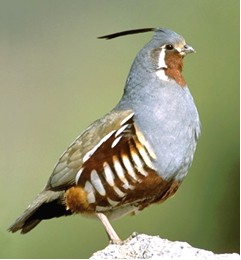 Photo By U.S. Fish & Wildlife Service - Pacific Region's , used under CC-BY-2.0 /Cropped and compressed from original
Description

The bird's average length is 26–28 cm (10–11 in), with a wingspan of 35–40 cm (14–16 in). They have relatively short, rounded wings and long, featherless legs. These birds are easily recognized by their top knots, which are shorter in the female. They have a brown face, gray breast, brown back and primaries, and heavily white barred underside. 
Size
28 cm (11 in)
Colors
Brown
Bronze
Gray
White
Life Expectancy
1-4 years
Nest Placement
Ground
Clutch Size
9 - 15 eggs
Number of Broods
24 - 25 days
Feeding Habits
Mountain Quail mainly consume plants and small insects. They forage on the ground, scratching and digging for seeds and invertebrates, and will climb for leaves or fruits. Diet changes seasonally, including fruits, acorns, pine nuts, mushrooms, and various plant seeds. Females and chicks prefer more insects, shifting to plants as chicks mature.
Habitat
Mountain Quail thrives in mountainous chaparral, dense shrubs, and vegetated areas west of the Rocky Mountains, reaching altitudes up to 3,000 m (9,800 ft). Their habitats span from the United States to Mexico's Baja peninsula, including specific locales such as British Columbia and Washington. They favor environments with a well-developed understory, including sagebrush and aspen, and adapt to disturbed terrains like burned forests and streamside thickets.
Nest Behavior
Mountain Quail males create a scrape for the nest, which is then lined by the female. Nesting includes a well-timed sequence of building, egg-laying, and meticulous parental care, crucial for offspring survival.
Nest Characteristics
Mountain Quail's nest is a depression on the ground, often at a sapling or shrub base within dense hillside vegetation. It is made by males and lined with grasses or pine needles by females. Rough size: 5.9 inches wide, 8 inches tall; cup 1.4 inches wide, 3 inches deep.
Dite type
Granivorous

General Info
Feeding Habits
Bird food type
Bird Feeder Type

Ground
Sounds
Call
Recording location: United States
Call
Recording location: United States
Call
Recording location: United States
Behavior
Mountain Quail display secretive and elusive tendencies, primarily active during dawn and dusk. These quails typically forage in dense vegetation for seeds and insects, occasionally venturing onto open trails for grit. Their social structure includes both solitary and collective behaviors, often forming family groups known as coveys. Males engage in unique courtship displays, such as food offerings and elaborate physical gestures to attract females. Both sexes exhibit dominance gestures, including a peculiar high-stepping walk. Aggressive encounters are common in the breeding season, with rival chases and pecking. Notably, courtship can involve a symbolic offering of vegetation. Post-hatching, mountain Quail are attentive parents, with both males and females sometimes assisting in chick rearing. Their adeptness at navigating their mountainous habitats exemplifies their specialized lifestyle.
Distribution Area
It inhabits mountainous chaparral west of the Rocky Mountains, from British Columbia in Canada, and some areas of Washington state in the United States, to Baja Peninsula, Mexico. It can be found up to 3,000 m (9,800 ft) above sea level. It is a non-migratory species; however some populations may be altitudinal migrants in some mountain ranges.
Species Status
It is not considered threatened by the IUCN, being plentiful across a wide range. However, its success is tied to sufficient habitat, which expands in cooler and more arid climate. Subfossil remains have been found, for example at Rocky Arroyo in the Guadalupe Mountains and Shelter Cave, New Mexico, where sufficient habitat no longer exists. The bones date found from the end of the last ice age to not much more than 8000 BC.
 Photo By U.S. Fish & Wildlife Service - Pacific Region's , used under CC-BY-2.0 /Cropped and compressed from original
Scientific Classification

Download Picture Bird
Identify any bird by photo or sound in seconds
Identify any bird by photo or sound in seconds