


Olive Warbler
A species of Olive Warblers Scientific name : Peucedramus taeniatus Genus : Olive Warblers
Olive Warbler, A species of Olive Warblers
Botanical name: Peucedramus taeniatus
Genus: Olive Warblers
Content
Description General Info

Description

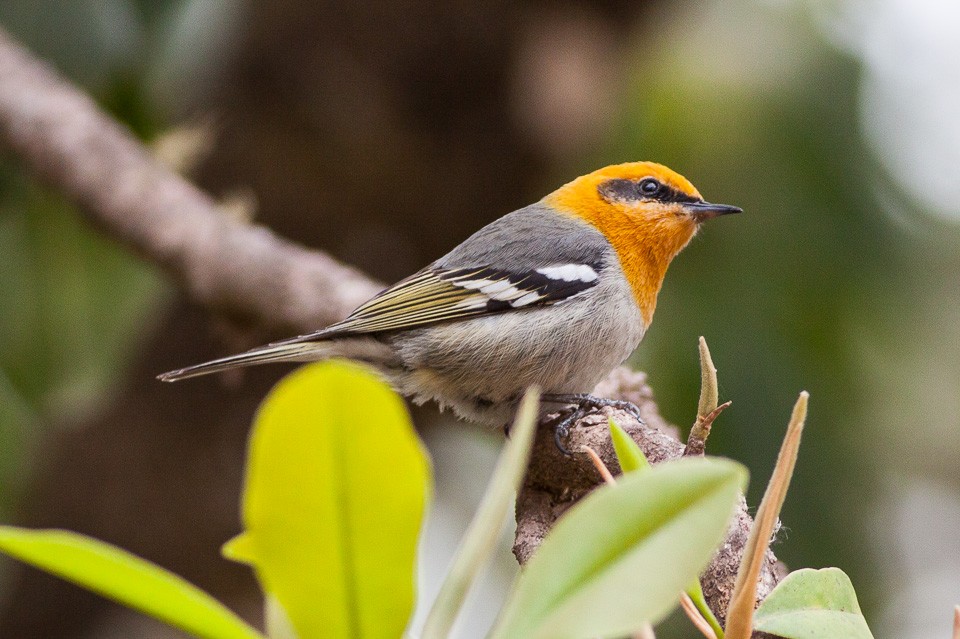
The olive warbler is a medium-sized warbler, 13 to 14 cm (5.1–5.5 in) in length and weighing 9.5 to 12 g (0.34–0.42 oz). It shows clinal variation in size, with more northern populations being larger than southern ones, a phenomenon known as Bergmann's rule. The olive warbler is a long-winged bird. The plumage of the male is mostly grey body with some olive-green on the wings and two white wing bars. The male's head and breast are "tawny-orange", and there is a black patch through the eye. In the female and juvenile, the orange is replaced by yellow, and the black mask is more diffuse. In addition to differences in size, plumage varies geographically as well, with southern birds having more brightly coloured plumage. The song consists of clear whistles rendered as hirrJI hirrJI hirrJI, plida plida plida chir chir, etc. The male sings throughout the year, with the frequency of the singing increasing in late winter and reaching a peak in early spring. During the year the male sings the most during the midmorning, but during spring the male sings constantly during mornings and late afternoon. Song is usually delivered from the canopy or other tall trees. 
Size
13 cm (5.25 in)
Life Expectancy
3 years
Nest Placement
Tree
Clutch Size
3 - 4 eggs
Incubation Period
1 brood
Feeding Habits
Olive Warbler actively hops through canopy branches, probing for insects in needle clusters and executing sallies to catch prey. Their diet primarily consists of insects and various arthropods.
Habitat
Olive Warbler is commonly found in open forests with specific types of coniferous and deciduous trees. They prefer habitats situated at higher elevations, typically above 6,000 feet, thriving in regions that include ponderosa pine, sugar pine, Douglas-fir, and a mix of oak species. The bird shows a particular affinity for pine-oak woodlands and pine-fir forests. Their habitat range extends to humid and semiarid zones, characterized by a mix of pine and alder trees, where the climate and vegetation offer suitable nesting and foraging opportunities.
Nest Behavior
The female olive Warbler is solely responsible for nest building. After construction, she lays the eggs, with the timing and exact patterns not specified. Both parents partake in caring for the eggs and young.
Nest Characteristics
Olive Warbler's nest is located at the canopy's edge of coniferous trees, 16 to 69 feet high, often amongst the last cluster of pine or fir needles. The female constructs a cup-shaped structure using rootlets, moss, lichens, spiderwebbing, and plant down.
Dite type
Insectivorous


General Info
Feeding Habits
Bird food type
Bird Feeder Type

Platform
Sounds
Song
Recording location: Mexico
Song
Recording location: Mexico
Behavior
The olive Warbler engages in meticulous foraging within the open pine forests' canopy, progressing unhurriedly across branches while inspecting clusters of needles or darting out to seize insects. As residents, often settled year-round, their behavior shifts slightly in the colder months, as some may venture southward. Winter sees them joining mixed-species flocks, exhibiting communal foraging strategies. Summertime strengthens their social bonds; they likely form monogamous pairings which could extend into winter. Communication is subtle yet persistent through soft calls amongst pairs, while males employ vocal displays from aloft to assert and guard their territory, intimidating rival males through aerial pursuits.
Distribution Area
The olive warbler is distributed from the southwestern United States to Nicaragua, making it the only bird family endemic to North America. In the northern part of its range it has a continuous distribution from Yavapai County, Arizona and the southwestern tip of New Mexico along central Mexico to southern Mexico. It has a disjunct distribution across the rest of its range, with populations in Tamaulipas, Coahuila and Sonora and Chihuahua in Mexico, and further south in southwest Guatemala and from northern El Salvador and central Honduras to northern Nicaragua. The olive warbler is a bird of mountains and highlands. In northern areas of its range it occurs from 2,600 m (8,500 ft) above sea level or more, in some parts of its range it may not occur below 3,500 m (11,500 ft). In Oaxaca in Mexico it occupies a range of between 1,700–3,000 m (5,600–9,800 ft) further south in Guatemala it ranges down to 1,850 m (6,070 ft) and at the southern end of its range it can be found as low as 1,000 m (3,300 ft) in Honduras and in Nicaragua it occupies a belt of forest from 1,070–1,370 m (3,510–4,490 ft) . They typically inhabit conifer forests, such as ponderosa and sugar pine forests in Arizona, Abies common fir forests, oak, and pine forests in central Mexico, Guatemala, and Honduras. These forests range from humid to semi-arid. In coastal regions stands of palms may be used, and in the Valley of Mexico pine and alder forests are inhabited. Over most of its range the species is resident, but there is evidence that the most northerly populations are partial migrants. Birds in Arizona, New Mexico, and Mexico apparently move away from their breeding grounds, although what exact movements are made is unclear. It has been suggested that they are either "down slope migrants", moving to lower elevations, or dispersive, as some records show their presence in Texas. Birds attributed to the northern race P. t. arizonae have been recorded near Tepic, in Nayarit. Nevertheless, some birds remain in the northern areas of their range year round.
Species Status
Not globally threatened.


Scientific Classification
Phylum
Chordates Class
Birds Order
Perching birds Family
Peucedramidae Genus
Olive Warblers Species
Olive Warbler 
Download Picture Bird
Identify any bird by photo or sound in seconds
Identify any bird by photo or sound in seconds