


Fawn-breasted Tanager
A species of Fawn-breasted Tanager Scientific name : Pipraeidea melanonota Genus : Fawn-breasted Tanager
Fawn-breasted Tanager, A species of Fawn-breasted Tanager
Botanical name: Pipraeidea melanonota
Genus: Fawn-breasted Tanager
Content
Description General Info
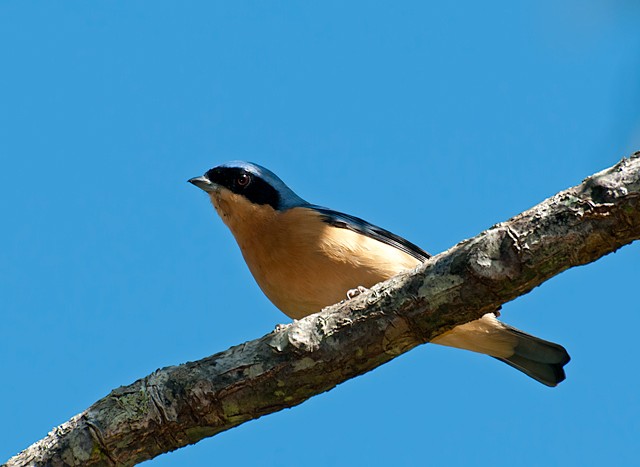 Photo By Dario Sanches , used under CC-BY-SA-2.0 /Cropped and compressed from original
Description

The fawn-breasted tanager has an average body length of 14 cm (5.5 in) and can weigh 18–25 g (0.63–0.88 oz). This species of tanager has an unusually short, wide beak, similar to the beaks of swallows, as well as short legs and tail, and long wings. The most noticeable coloration of this species is its sky-blue crown and broad black mask that extends over the eyes into ear-coverts. The coloration of male crown and nape is a medium blue, and the forehead, lores, ocular area and ear-coverts are deep black. The mantle and back of males are a dull blue color, the lower back and rump a bright turquoise-blue, tail dusky blue, throat and the underparts of the body are a cinnamon color. The iris is a dark red to reddish-brown color, and the bill is dusky with a lower mandible that is normally grey. The female has a similar coloration but is usually duller, particularly in the crown region, and with a brownish coloration on the back. Juveniles are almost without pattern and have a dull brownish-grey coloring. The fawn-breasted tanager is usually seen singly or in pairs, most often in the semi-open, but it may perch at any height. Calls consist of "see" or "swee" tones varying in sets of 4 or 5 notes sung slowly, or a higher number of notes, around a dozen, uttered in a pulsating trill pattern in a faster rhythm. 
Size
14 cm
Nest Placement
Tree
Feeding Habits
Fawn-breasted Tanager consume a varied diet of vegetable matter like berries and seeds, as well as insects, including moths and their larvae. Typically feeding alone, fawn-breasted Tanager may join mixed-species flocks at fruiting trees, exhibiting no unique dietary adaptations.
Habitat
Fawn-breasted Tanager is commonly found in montane evergreen forest edges, including tropical lowland forest margins and secondary forests. These birds inhabit upper tropical to lower temperate areas, favoring forest borders, light woodlands, overgrown pastures, and cultivated semi-open landscapes with large trees. They also occupy clearings, gardens, and other non-forest environments. Geographically, fawn-breasted Tanager ranges broadly across South America, with altitude tolerances varying from as low as 400 m in Venezuela to as high as 3000 m in the Andes.
Dite type
Frugivorous


General Info
Feeding Habits
Bird food type

Fruit
Distribution Area
The range of the fawn-breasted tanager extends throughout South America, covering most of Brazil, Venezuela, Colombia, Peru, Ecuador, Bolivia, east Paraguay, Uruguay, Northeastern Argentina, following towards the southern bank of the Río de la Plata. The species can be found in habitats along forest borders, bushy pastures, and cultivated small semi open areas with large trees and clearings with scattered trees. The elevation range that this species can tolerate varies geographically. In the Andes and Ecuador it can be found at altitudes of 1500–2500 m, with a maximum of 3000 m. In Colombia, it occurs down to 900 m, and in Venezuela to 400 m.
Species Status
The species is currently classified as Least Concern by the IUCN due to its extremely large range, variety of habitats and apparently large population size. Due to opening of forested areas through agriculture and other anthropogenic changes, it may be expanding its range locally.


Scientific Classification
Phylum
Chordates Class
Birds Order
Perching birds Family
Tanagers Genus
Fawn-breasted Tanager Species
Fawn-breasted Tanager 
Download Picture Bird
Identify any bird by photo or sound in seconds
Identify any bird by photo or sound in seconds