


Ruddy-tailed Flycatcher
A species of Ruddy-tailed Flycatcher Scientific name : Terenotriccus erythrurus Genus : Ruddy-tailed Flycatcher
Ruddy-tailed Flycatcher, A species of Ruddy-tailed Flycatcher
Botanical name: Terenotriccus erythrurus
Genus: Ruddy-tailed Flycatcher
Content
Description General Info
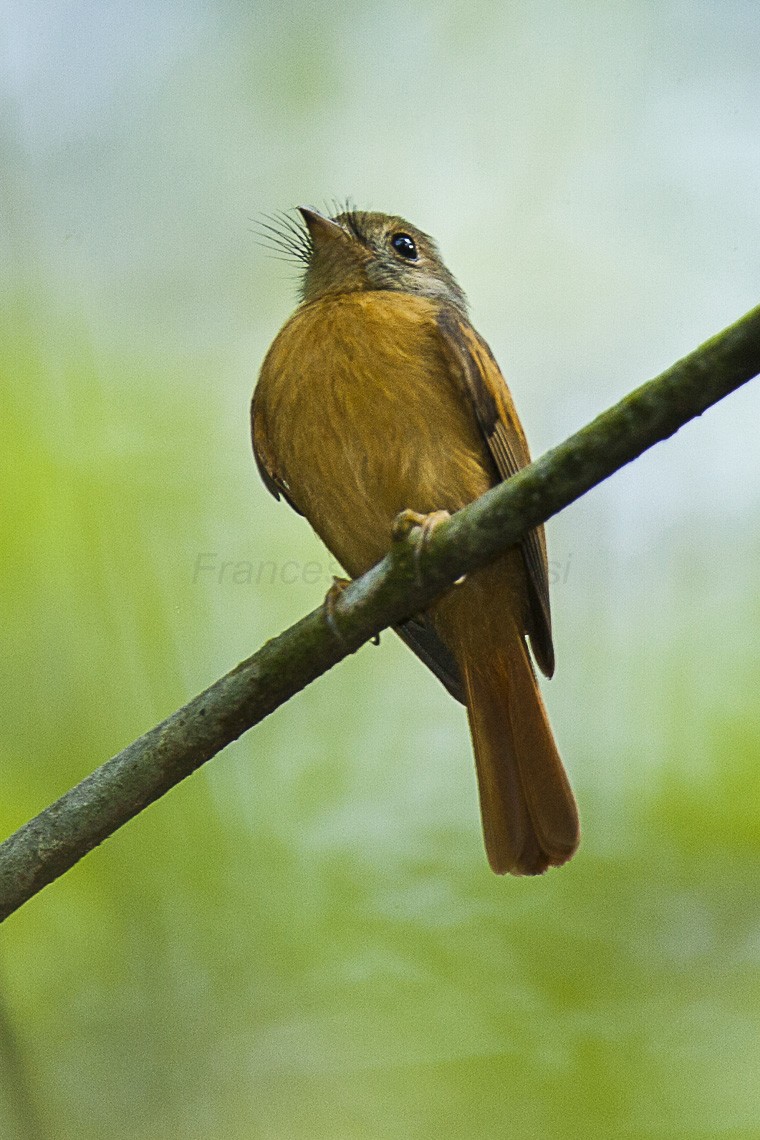 Photo By Francesco Veronesi , used under CC-BY-SA-2.0 /Cropped and compressed from original
Description

The ruddy-tailed flycatcher (Terenotriccus erythrurus) is a small passerine bird in the family Tityridae. It breeds in lowlands from southeastern Mexico to northern Bolivia, north-central Brazil and the Guianas. This flycatcher ranges east of the Andes cordillera into the entire Amazon Basin of northern Brazil and the Guianas; to the west of the Andes in Colombia and Ecuador into Central America. It is the only member of the genus Terenotriccus, but some authorities place it in genus Myiobius. However, it differs in voice, behaviour, and structure from members of that group. This tiny flycatcher breeds from sea level to 1,000 m (3,300 ft) altitude, locally to 1,200 m (3,900 ft), in wet mountain forests and in adjacent tall second growth. The nest is a pear-shaped pouch of plant fibres and leaves with a visored side entrance, built by the female 2–6 m high in the undergrowth and suspended from a twig or vine. The two chocolate-blotched white eggs are incubated by the female for 15–16 days to hatching, the male playing no part in the care of the eggs or young. The ruddy-tailed flycatcher is 9.0–10.2 cm (3.5–4.0 in) long and weighs 7 g (0.25 oz). The upperparts are grey-olive, with a rufous rump, tail, wings and eye ring. The throat is buff and the breast is cinnamon, becoming pale buff on the belly. Sexes are similar, but young birds are brighter above and have a browner tail and breast. The ruddy-tailed flycatcher is mainly solitary, and only occasionally joins mixed-species feeding flocks. It feeds on insects, especially leafhoppers, picked from foliage or taken in acrobatic aerial pursuit. This species has a see-oo see call, and a repetitive eek eek eek eek eek song. It sometimes flicks both wings up to make a faint whirring sound. 
Size
11 cm
Nest Placement
Tree
Feeding Habits
Ruddy-tailed Flycatcher primarily feasts on small insects like homopteran bugs and ants, along with other varieties such as beetles and hymenopterans. This species exhibits specialized foraging techniques, adeptly hunting these insects to meet its dietary needs.
Habitat
Ruddy-tailed Flycatcher predominantly inhabits the understory and mid-levels of both terra firme and várzea forests, as well as thriving in secondary growth woodlands. These birds are versatile and can also be found in cultivated areas such as coconut groves. Their range extends from the lowlands up to elevations of 1200 meters, indicating a preference for warm, tropical environments across broad geographical regions within suitable latitudes.
Dite type
Insectivorous


General Info
Feeding Habits
Bird food type
Species Status
Not globally threatened.


Scientific Classification
Phylum
Chordates Class
Birds Order
Perching birds Family
Tyrant flycatchers Genus
Ruddy-tailed Flycatcher Species
Ruddy-tailed Flycatcher 
Download Picture Bird
Identify any bird by photo or sound in seconds
Identify any bird by photo or sound in seconds