


White-necked Thrush
A species of True thrushes Scientific name : Turdus albicollis Genus : True thrushes
White-necked Thrush, A species of True thrushes
Botanical name: Turdus albicollis
Genus: True thrushes
Content
Description General Info
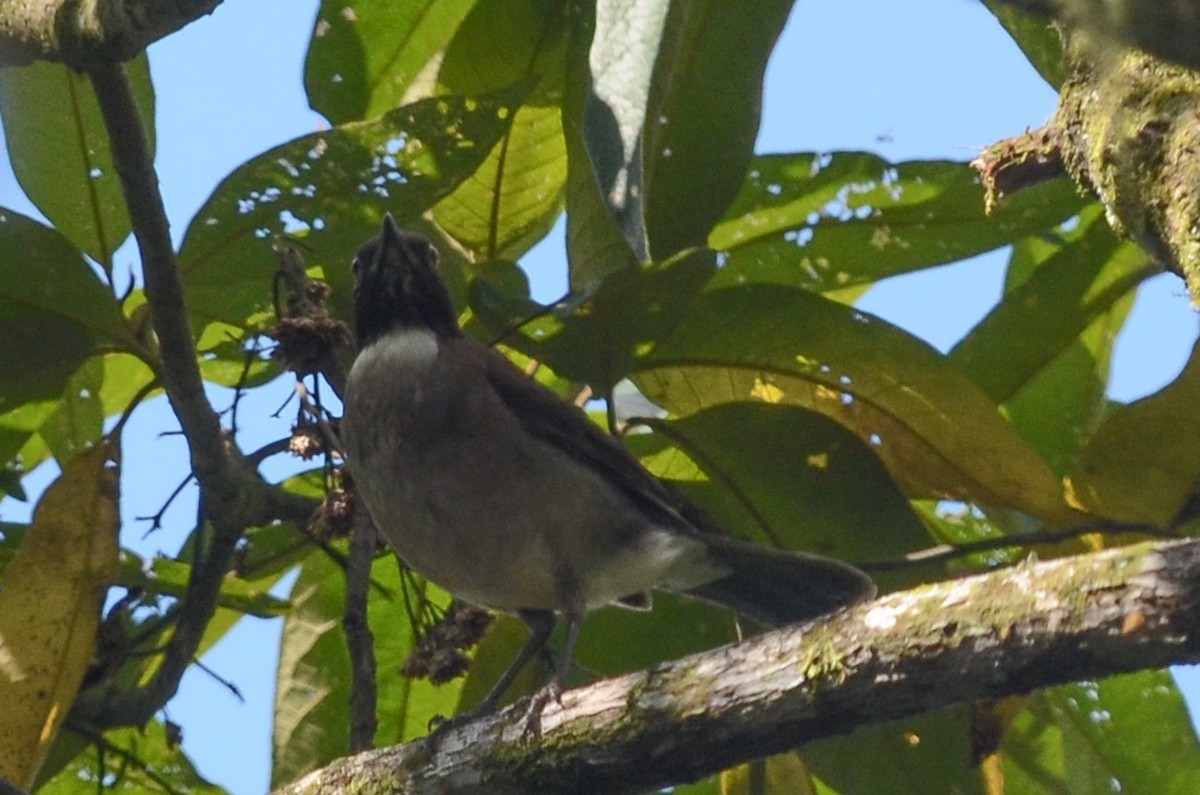 Photo By Nikolaj Mølgaard Thomsen
Description

This thrush is 20 ⁄2–26 cm (8.1–10.2 in) long and weighs 40–77 g (1.4–2.7 oz). The upperparts are dark brown, turning duskier or greyer towards the ocular region. The throat is white with dense dark streaks, except on the lowermost part, resulting in the appearance of a white crescent below the dark-streaked white throat. This has given rise to both its English and scientific name. The crissum (the undertail coverts surrounding the cloaca) and central belly are whitish, and the chest is grey often tinged brown. The members of the nominate group have conspicuous rufous flanks, and the bill is yellow with a dusky culmen. The flanks are paler and more tawny in the subspecies crotopezus, which also has the entire upper mandible dusky. The members of the phaeopygos group lack contrasting rufous or tawny flanks, and have bills that are almost entirely dusky. All subspecies have pinkish-brown legs and a reddish or yellow eye-ring. Sexes are similar, but juveniles are duller, with dull orange spotting above, and brownish spotting below. The song is a relatively musical, often rather monotonous two-e-o, two-e. The calls is a distinctive wuk, while the alarm is a rough jjig-wig-wig. 
Size
26 cm
Nest Placement
Tree
Habitat
The habitat of white-necked Thrush typically consists of forested environments, favoring the underbrush, lower strata, and sometimes the mid-levels of humid forests, including both terra firme and várzea types. This species is also found in forest borders, mature secondary woodlands, and clearings, displaying a preference for wooded areas over exposed spaces.
Dite type
Omnivorous

General Info
Feeding Habits
Bird food type
Behavior
The white-necked thrush mainly feeds on or near the ground on invertebrates. It also takes some fruit and berries. It regularly follows army ant swarms, but does not attend mixed species flocks. Throughout most of its range, especially in the Amazon, it is a shy species, heard far more than seen, but in Trinidad and parts of south-eastern Brazil it may be less retiring. The nest is a lined cup of twigs placed low (at a height of 1–9 m [3.3–29.5 ft]) in a tree or bush. Two to three reddish-blotched green-blue eggs are laid and incubated by the female alone for 12–13 days. Social mongamous, but extra-pair mate are common.
Distribution Area
The nominate group (including subspecies paraguayensis and crotopezus) occurs in eastern Brazil, far northern Uruguay, eastern Paraguay and far north-eastern Argentina. The phaeopygos group (including subspecies phaopygoides, spodiolaemus and contemptus) is mainly found in the Amazon Basin, but with populations extending along the eastern slope of the Andes as far south as north-eastern Argentina, and as far north as western Venezuela, with extensions along the Coastal Range, the region centered around Serranía del Perijá and Sierra Nevada de Santa Marta, and the islands of Trinidad and Tobago. Both groups are mainly associated with humid forest and woodland. In the case of the nominate group, mainly the Atlantic Forest, and in the case of the phaeopygos group, mainly the Amazon Rainforest or humid forests and woodlands near mountains. It rarely ventures far from cover.
 Photo By Nikolaj Mølgaard Thomsen
Scientific Classification
Phylum
Chordates Class
Birds Order
Perching birds Family
Thrushes Genus
True thrushes Species
White-necked Thrush 
Download Picture Bird
Identify any bird by photo or sound in seconds
Identify any bird by photo or sound in seconds