


Mountain Thrush
A species of True thrushes Scientific name : Turdus plebejus Genus : True thrushes
Mountain Thrush, A species of True thrushes
Botanical name: Turdus plebejus
Genus: True thrushes
Content
Description General Info
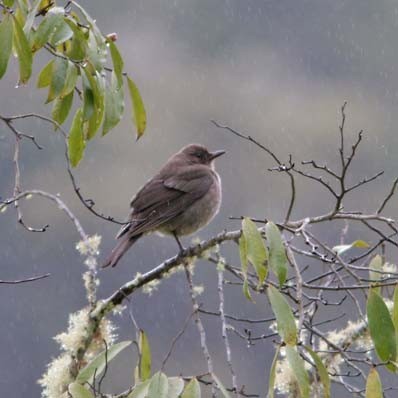 Photo By Don Roberson
Description

The mountain thrush resembles other Turdus thrushes in general appearance and habits. It is 23–26 cm (9.1–10.2 in) long and weighs 86 g (3.0 oz) on average. The adult is uniformly dull olive-brown with faint white streaks on the throat. The bill is black and the legs are dark brown. The juvenile resembles the adult, but has buff or orange streaks on the head and upperparts, and dark spotting on the underparts. Two superficially similar relatives share this species range: the sooty thrush is blacker with an orange bill, eye ring and legs, and the clay-colored thrush is much paler and yellow-billed. There are three poorly defined subspecies: T. p. plebejus — Cabanis, 1861 — nominate, found in the mountains of Costa Rica and western Panama, described above T. p. differens — (Nelson, 1901) — found from the Pacific slope of Mexico to Caribbean Guatemala is more olive above, and more olive brown and less grey below T. p. rafaelensis — Miller, W & Griscom, 1925 — found in the highlands from Honduras to northwestern Nicaragua is intermediate between the northern and southern subspecies above, and is often merged with differens 
Size
26 cm
Nest Placement
Tree
Feeding Habits
Mountain Thrush consumes a diverse diet including arillate seeds, berries, insects, and various invertebrates. Mountain Thrush's foraging technique involves active searching on the forest floor and in vegetation. A unique adaptation is mountain Thrush's preference for certain berry species when available.
Habitat
The mountain Thrush is native to humid montane evergreen forests, often frequenting the forest edges. It thrives in habitats that feature towering trees coated with mosses, liverworts, ferns, and flowering epiphytes. Additionally, the mountain Thrush can be spotted in pastures punctuated with moss-draped trees and is known to visit open groves populated by small trees abundant in berries, as well as areas of low second growth, especially outside the breeding season.
Dite type
Omnivorous

General Info
Feeding Habits
Bird food type
Behavior
The mountain thrush behaves like other thrushes. It forages on large branches or on the ground, in flocks when not breeding, progressing in hops and dashes with frequent stops. It turns leaf litter seeking small fruits, insects and spiders.
Distribution Area
This is a bird of tall mountain forests and adjacent more open areas and woodland edge which breeds in highlands from southern Mexico to western Panama. Its preference is for oak with many epiphytes and mosses, normally from 1,800 m (5,900 ft) altitude to the timberline. It descends in flocks as low as 900 m (3,000 ft) in the wet season.
 Photo By Don Roberson
Scientific Classification
Phylum
Chordates Class
Birds Order
Perching birds Family
Thrushes Genus
True thrushes Species
Mountain Thrush 
Download Picture Bird
Identify any bird by photo or sound in seconds
Identify any bird by photo or sound in seconds