



Top 20 Most Common Bird in Mashonaland East
The multifaceted environment of Mashonaland East offers a diverse habitat for birds. Among the 20 most common species, many showcase striking features or unique behaviors. This includes the Southern Ground-Hornbill with its vivid facial markings, or the African Fish Eagle, known for its distinctive hunting technique. These winged residents demonstrate the richness of Mashonaland East's avian life.

Most Common Bird
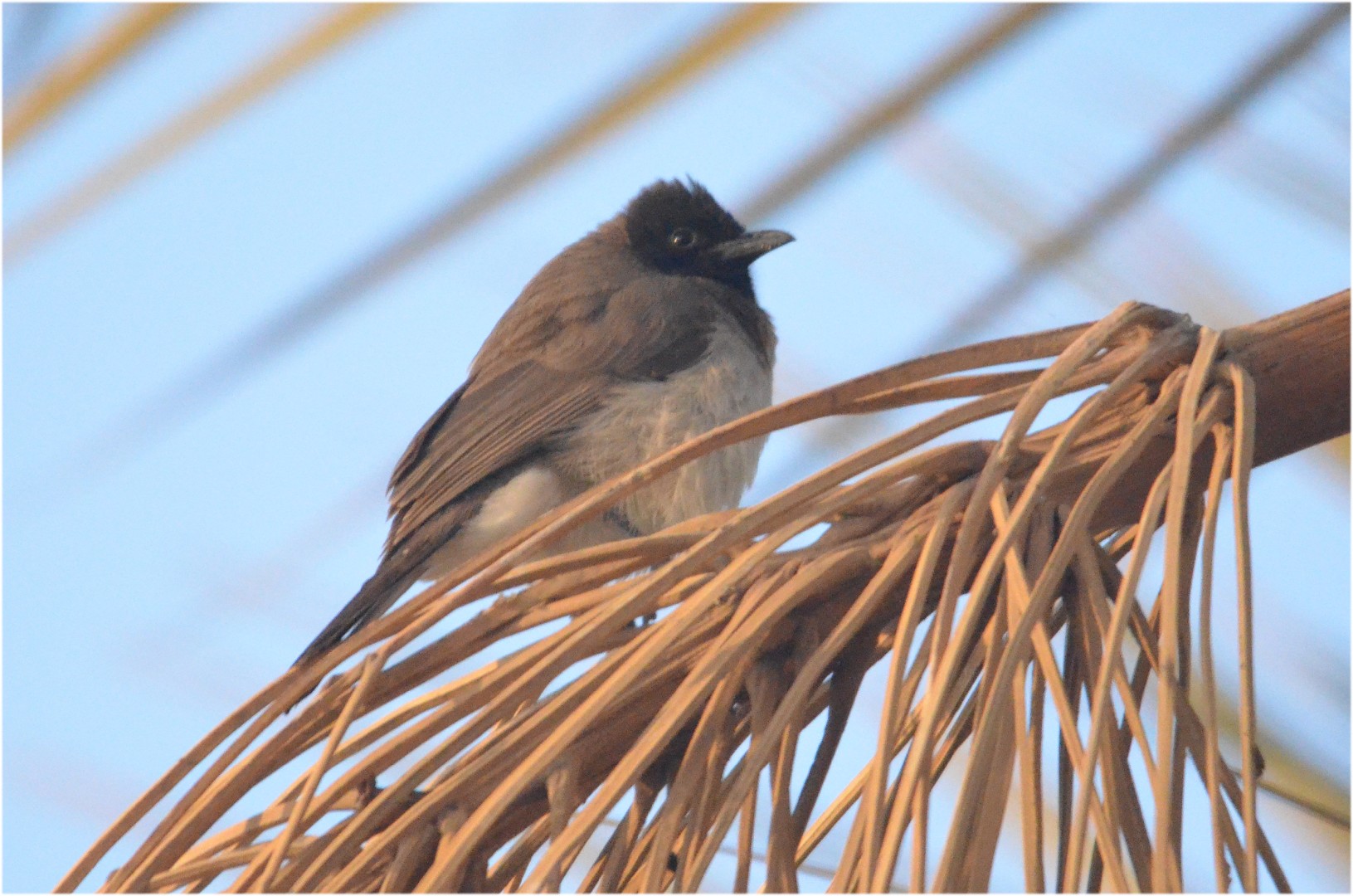
1. Common Bulbul
The bill is fairly short and thin, with a slightly downcurving upper mandible. The bill, legs, and feet are black and the eye is dark brown with a dark eye-ring, which is not readily visible. It is about 18 cm in length, with a long tail. It has a dark brown head and upperparts. Sexes are similar in plumage. 
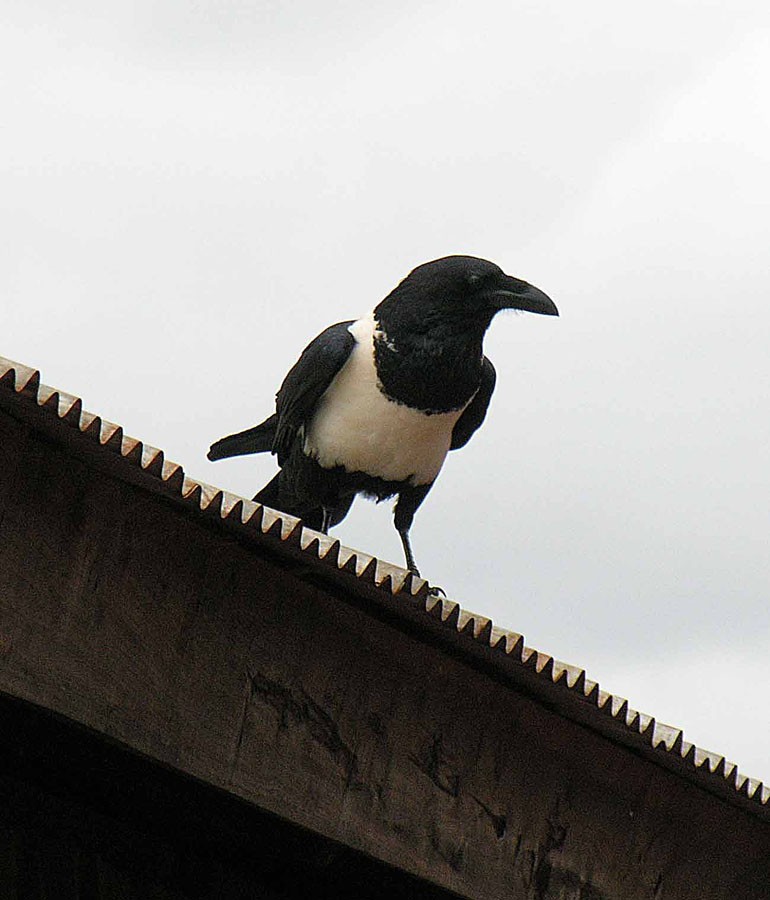
2. Pied Crow
It is approximately the size of the European carrion crow or a little larger (46–50 cm in length) but has a proportionately larger bill, slightly longer tail and wings, and longer legs. As its name suggests, its glossy black head and neck are interrupted by a large area of white feathering from the shoulders down to the lower breast. The tail, bill and wings are black too. The eyes are dark brown. The white plumage of immature birds is often mixed with black. It resembles the white-necked and thick-billed ravens but has a much smaller bill.
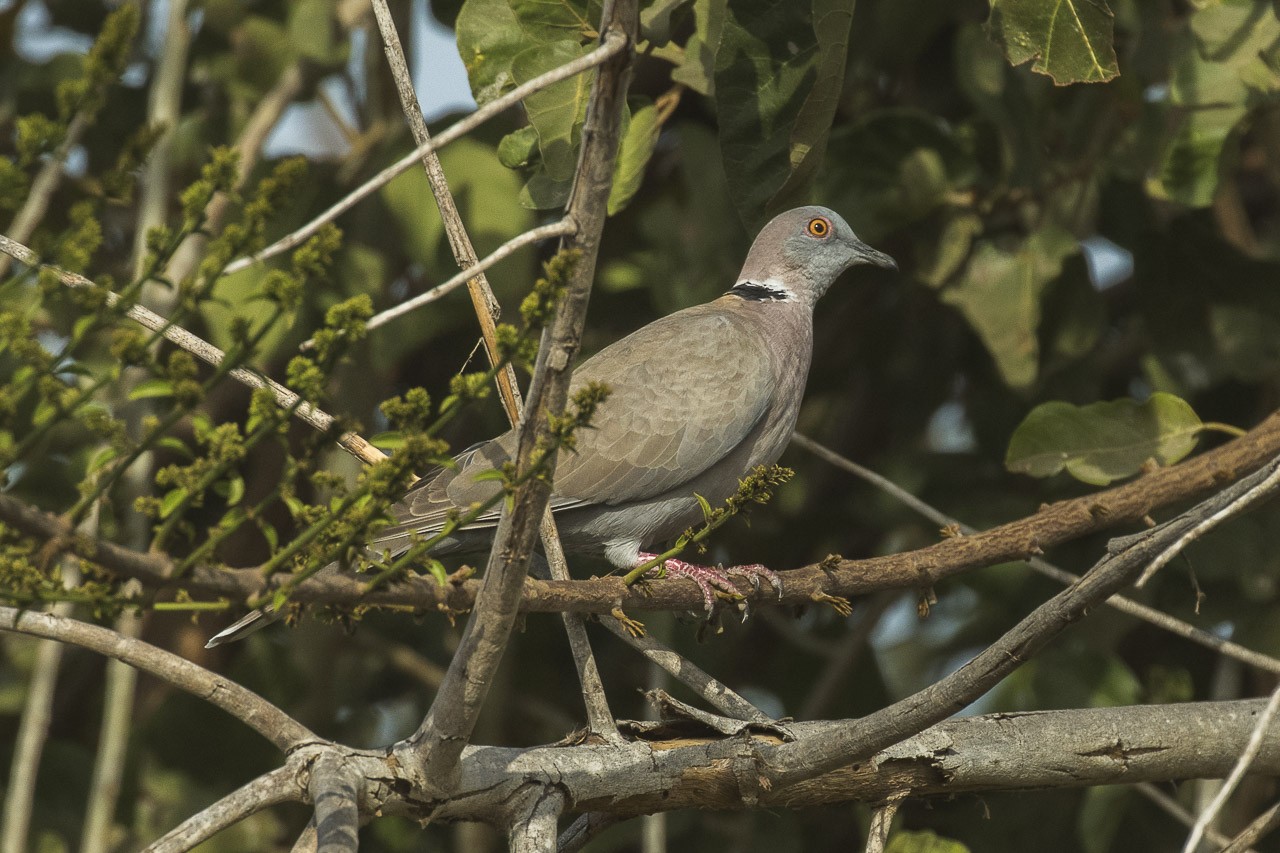
3. Red-eyed Dove
The red-eyed dove is a largish, stocky pigeon, typically 30 cm (12 inches) in length. Its back, wings and tail are pale brown. When flying, it shows blackish flight feathers. The head and underparts are dark vinous-pink, shading to pale grey on the face. There is a black hind neck patch edged with white. The legs and a patch of bare skin around the eye are red. The call is a loud doo-doo-du-du. Sexes are similar, but juveniles are duller than adults, and have scalloping on the body feathers. Red-eyed doves eat grass seeds, grains and other vegetation. They often forage on the ground.
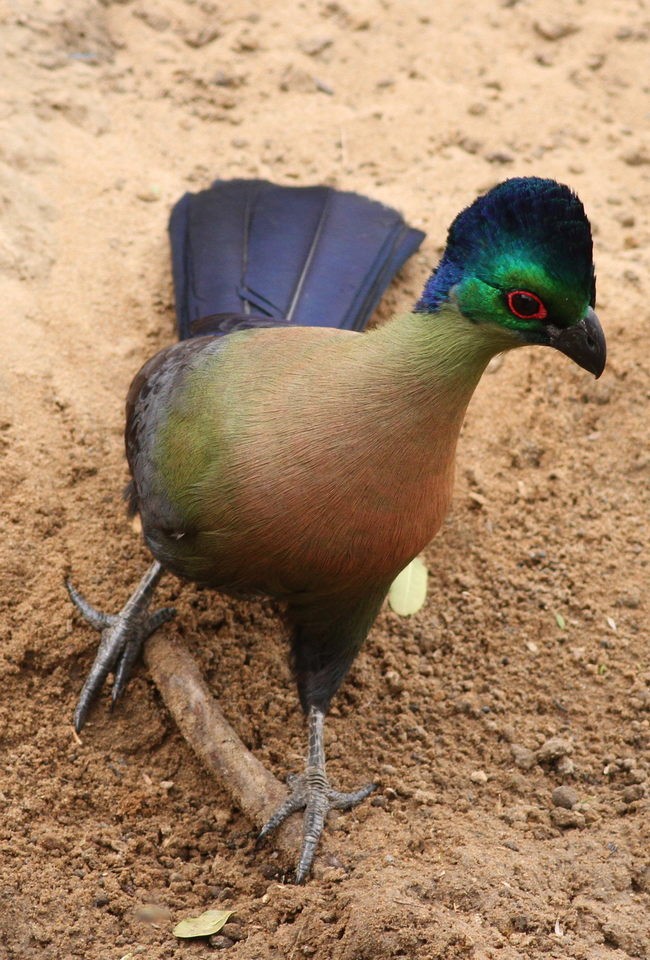
4. Purple-crested Turaco
This bird has a purple coloured crest above a green head, a red ring around their eyes, and a black bill. The neck and chest are green and brown. The rest of the body is purple, with red flight feathers.
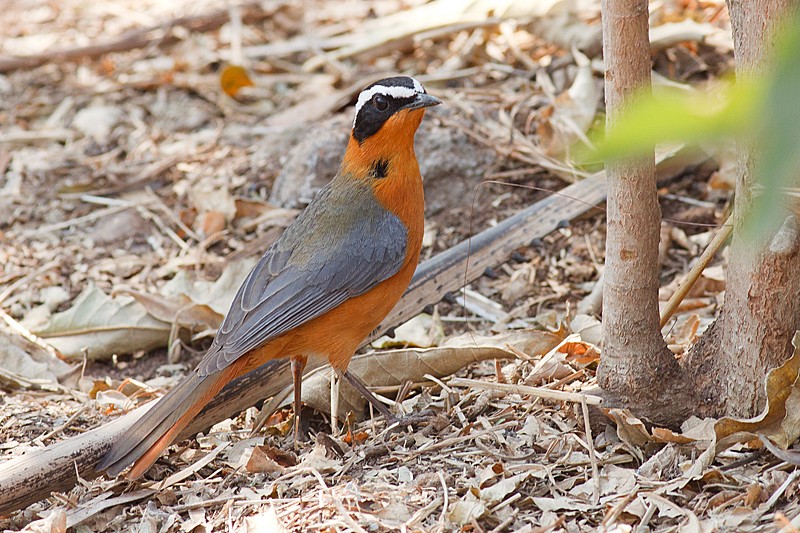
5. White-browed Robin-chat
The white-browed robin-chat is 19–20 cm (7.5–7.9 in) long and weighs 29–51 g (1.0–1.8 oz). The crown and face are black, and there is a white supercilium over the dark brown eye. The back is olive grey-brown, and the rump is rufous. The two central tail feathers are olive-brown, and the other feathers are orange-rufous. The flight feathers and wing coverts are grey-brown, and the underwing coverts are rufous. The underparts are bright orange-rufous. The beak is black, and the legs are pinkish brown, brownish grey or dark brown. The female is a little smaller than the male. The juvenile bird has a brown head and rufous-brown marks on its back. Its throat is pale, its breast is pale orange-buff, and its belly is pale orange.
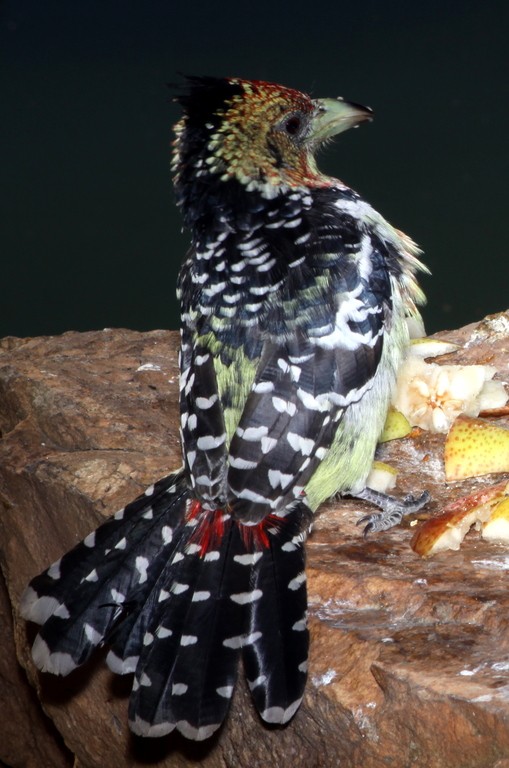
6. Crested Barbet
With its thick bill and very colourful plumage the crested barbet is unmistakable. This small bird has a speckled yellow and red face with a small black crest. The belly is yellow with red speckles, wings are black with white specks and it has a broad black band on its neck. Yellow head and body with black and white feathers, red markings on end of body, its colour blends well in the bush. They have a distinct trill.
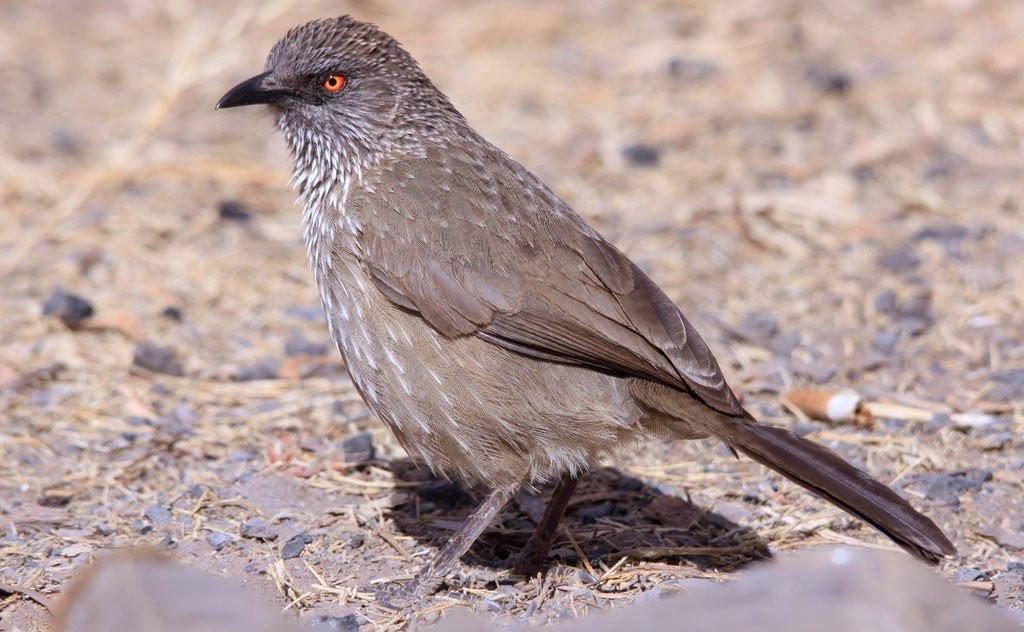
7. Arrow-marked Babbler
The arrow-marked babbler is a medium-sized babbler, 22 to 25 cm (8.7–9.8 in) in length and weighing 56 to 85 g (2.0–3.0 oz). The common name for the species is derived from its plumage, which is brownish-grey above and lighter below, with white tips to the feathers on the throat, neck and head. The iris is bright red and the inner ring of the eye bright yellow or orange. The males and females are identical in appearance. Juveniles have brown eyes, and less arrow-shaped streaking on the breast.
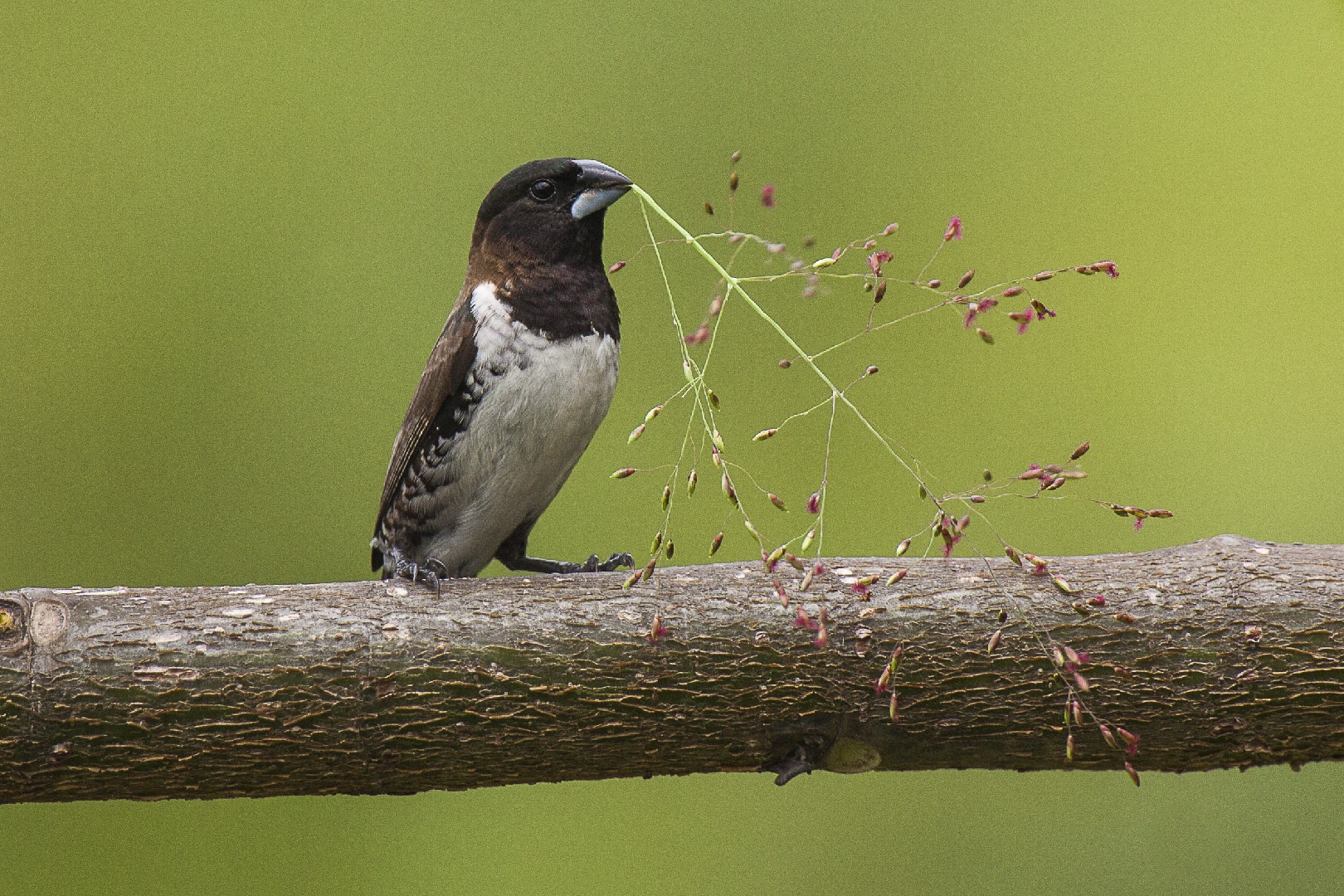
8. Bronze Mannikin
The bronze mannikin is one of the smallest munia species, measuring 9–10 cm in length and weighing 7–12 grams. The adult is a compact bird with a short black tail, and stubby black and pale grey (not distinctly bluish) mandibles. It is black to brownish black on the head, chin, throat and center of the chest, with some purple-green iridescence on the face and sides of the breast. It has greyish brown upper parts and white underparts with irregular barring on the flanks and rump. A small green iridescent patch is present on the outer scapular feathers, besides, especially in the western race, the sides of the lower breast. Wing coverts and remiges are bordered in a paler or warmer tone. The sexes are similar. Immature birds are dun brown above with buff head and underpart plumage. They moult into full adult plumage by age six months, when the males also begin to sing and exhibit breeding behaviour.
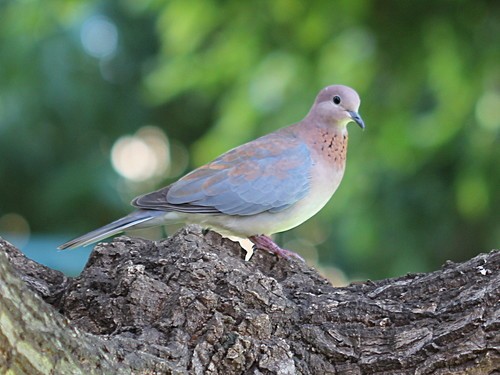
9. Laughing Dove
The laughing Dove is a small dove named after its distinctive laugh-like vocalization. This ground-feeding, non-migratory bird is a regular inhabitant of man-altered environments such as villages, gardens, and orchards. In cities, these doves tend to become quite confident. They pair for life and live in very small communities.
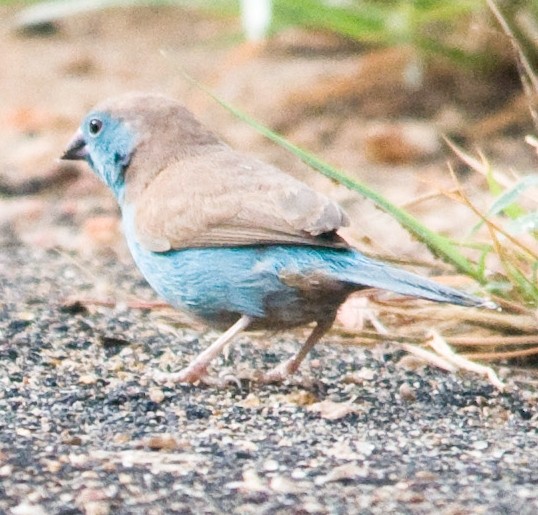
10. Blue-breasted Cordonbleu
The blue waxbill has powder-blue face, breast, rump, and flanks with pale brown upperparts. The female is paler than the male and the blue is confined to the rump, tail, head, and upper breast, with the rest of the underparts being buffy brown. They measure 12–13 cm in length.
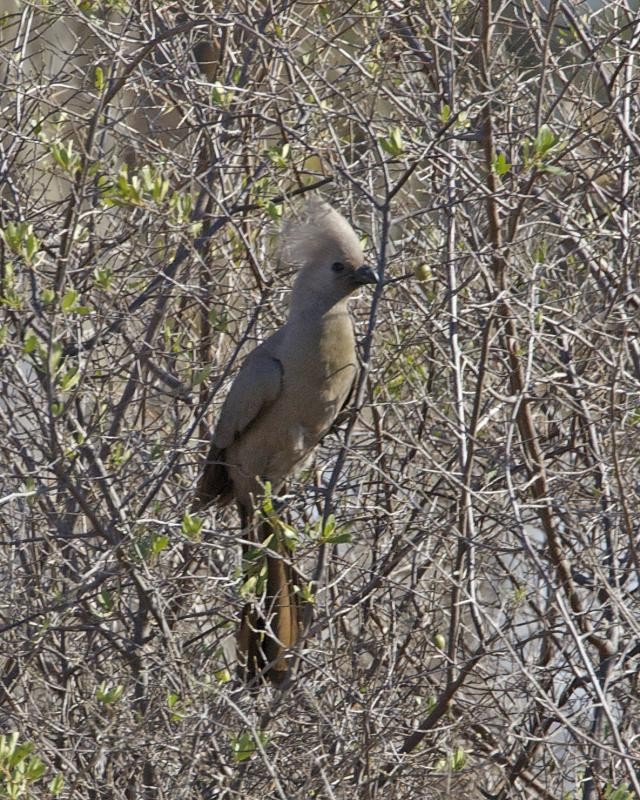
11. Grey Go-away-bird
The sexes are similar. They measure 47–51 cm from bill tip to tail tip, and weigh some 200 to 300 g. They have an almost uniform smoky-grey plumage with long tails and (similar to mousebirds) a wispy, back-swept crest of some 6 to 7 cm in length. The crest can be raised almost vertically when excited. The strong, decurved beak is black and the gape and tongue strikingly pink. The plumage is darkest grey on the chin and throat, and palest around the eyes and on the belly. The breast plumage is washed slightly olive like that of its near relative, the bare-faced go-away-bird.
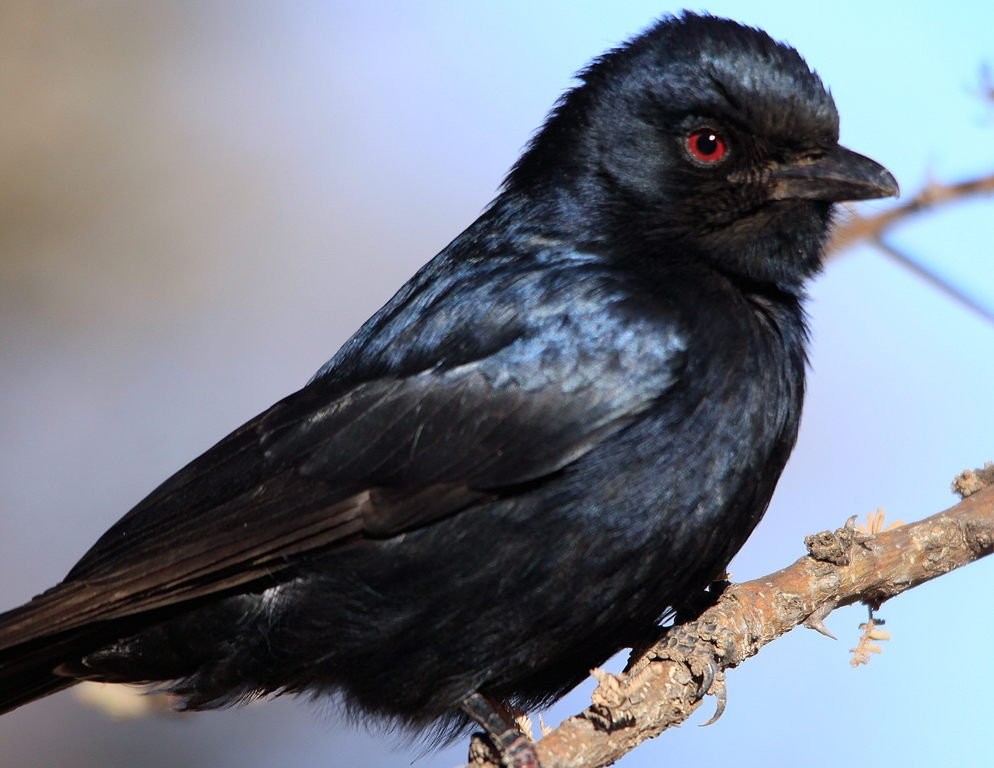
12. Fork-tailed Drongo
The fork-tailed drongo is 25 cm long and has short legs. They are medium sized and usually weigh about 50 grams. Males are mainly glossy black, although their wings are duller. Females are similar but less glossy. It is large-headed with well-developed rictal and nasal bristles, which are used as sensory organs. The rectrices curve outwards, forming the forked tail for which the species is named. The hooked bill is black and heavy, and the eye is red.
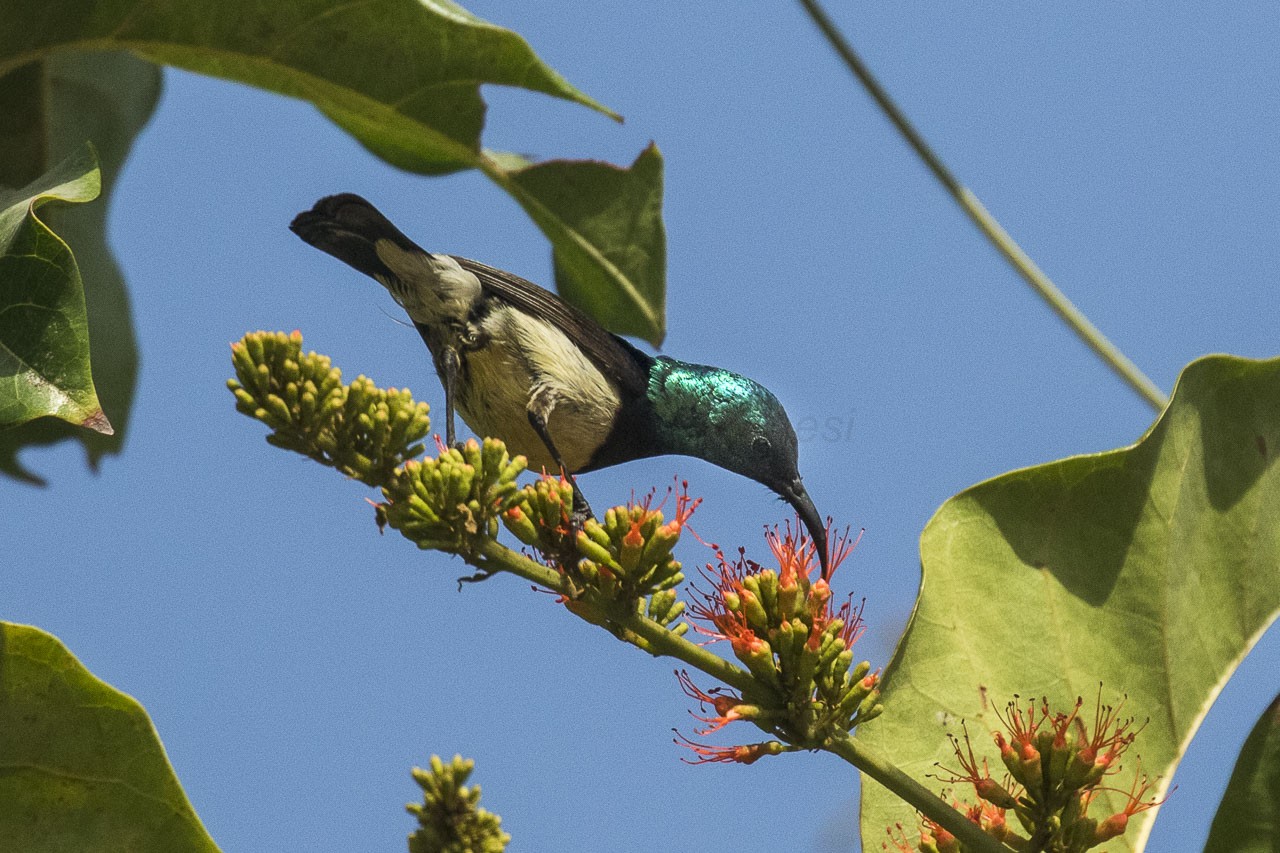
13. Variable Sunbird
The variable sunbird (or yellow-bellied sunbird), Cinnyris venustus (formerly Nectarinia venusta), is a sunbird. The sunbirds are a group of small Old World passerine birds which feed largely on nectar, although they will also take insects, especially when feeding young. Flight is fast and direct on their short wings. Most species can take nectar by hovering like a hummingbird, but usually perch to feed most of the time. The variable sunbird is a fairly common resident breeder in equatorial Africa. Two eggs are laid in a suspended nest in a tree. This species is found in open woodland and cultivation. Variable sunbirds are small, only 10 cm long. They have medium-length thin down-curved bills and brush-tipped tubular tongues, both adaptations to their nectar feeding. The adult male has a glossy green head, throat and nape, and a maroon breast band. In most subspecies, the belly of the male is yellow, but in a few it is orange or white. The female has grey-brown upperparts and yellowish underparts, and an obvious pale supercilium. The eclipse male is like the female, but shows some green, especially on the throat. The call is a clear tew-tew-tew-tew-tew .
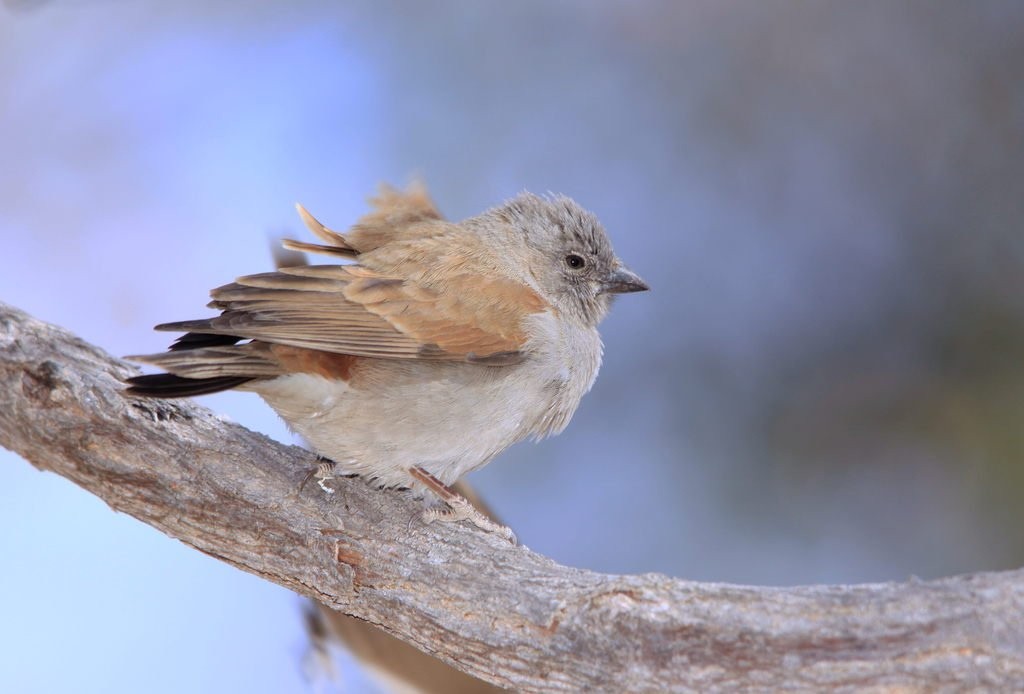
14. Southern Grey-headed Sparrow
The southern grey-headed sparrow (Passer diffusus) is a passerine bird of the sparrow family Passeridae. It is sometimes treated as a subspecies of the grey-headed sparrow. It is found in savanna and woodland in Angola and Zambia southwards into South Africa, where it is expanding its range and is kept as a caged bird, like its relative the white-rumped seedeater.
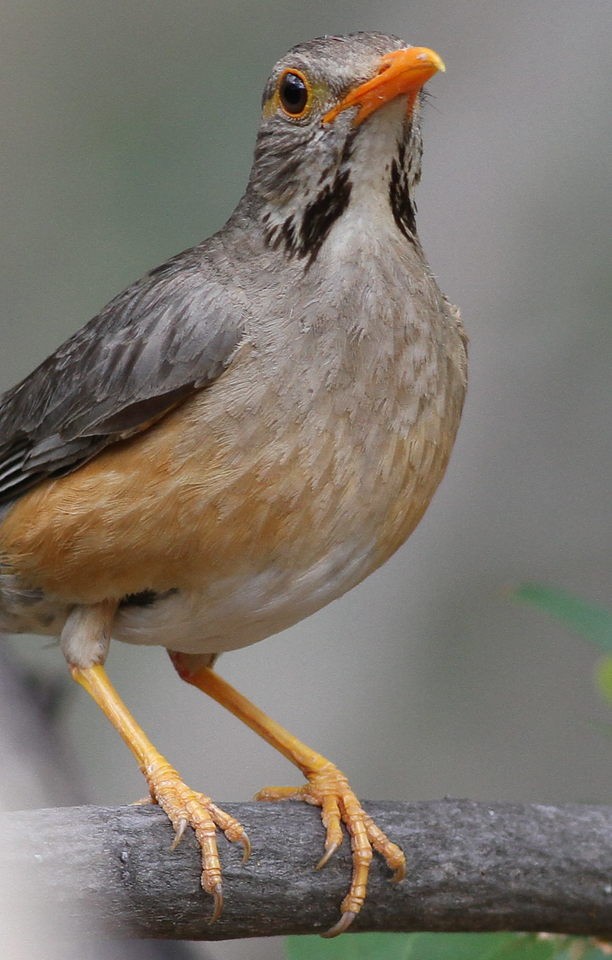
15. Kurrichane Thrush
The Kurrichane thrush is 21 to 23 cm (8.3–9.1 in) long and weighs around 46–82 g (1.6–2.9 oz). The head, upperparts and breast are grey, and the belly is whitish with orange flanks. The throat is white with black streaks on the side. The bill is orange, tending to a paler yellow at the base. The legs tend to vary in colour. Both sexes are alike.
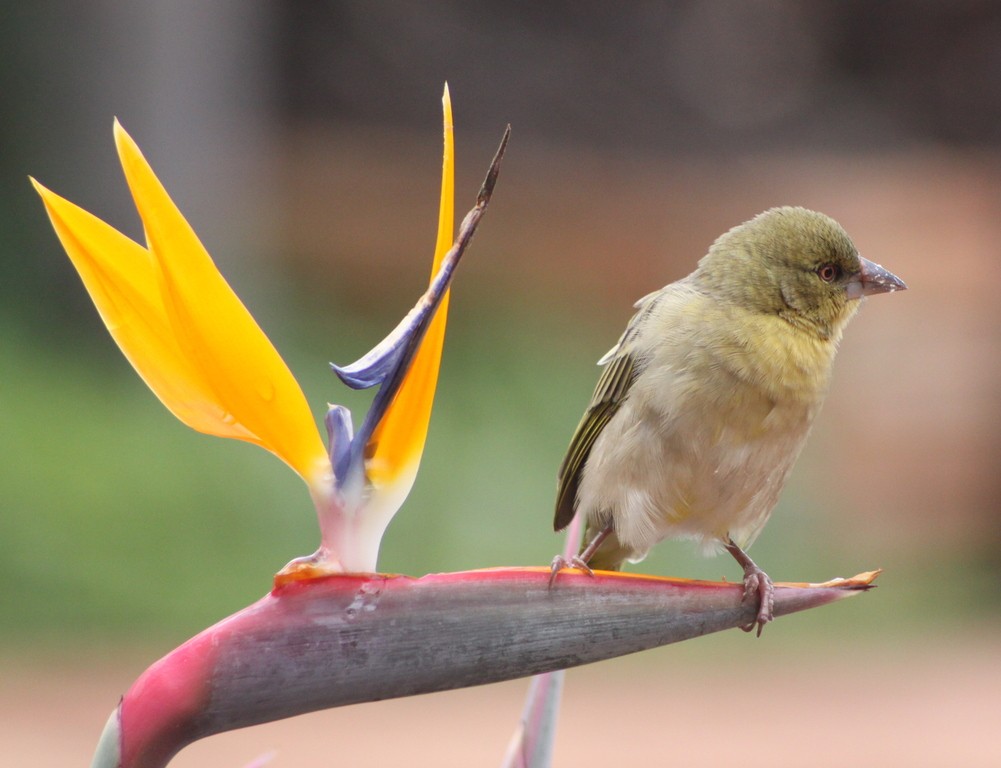
16. Southern Masked Weaver
The southern masked weaver is 11–14.5 cm (4.3–5.7 in) long with a short, strong, conical bill and pinkish brown legs. The adult male in breeding plumage has a black face, throat and beak, red eye, bright yellow head and underparts, and a plain yellowish-green back, The female has a pinkish-brown bill, brown or red-brown eye and is dull greenish-yellow, streaked darker on the upper back. The throat is yellowish, fading to off-white on the belly. The non-breeding male resembles the female but retains the red eye. The juvenile of this species is like the female. The call is a harsh swizzling, similar to other weavers. It also utters a sharp chuk alarm note.
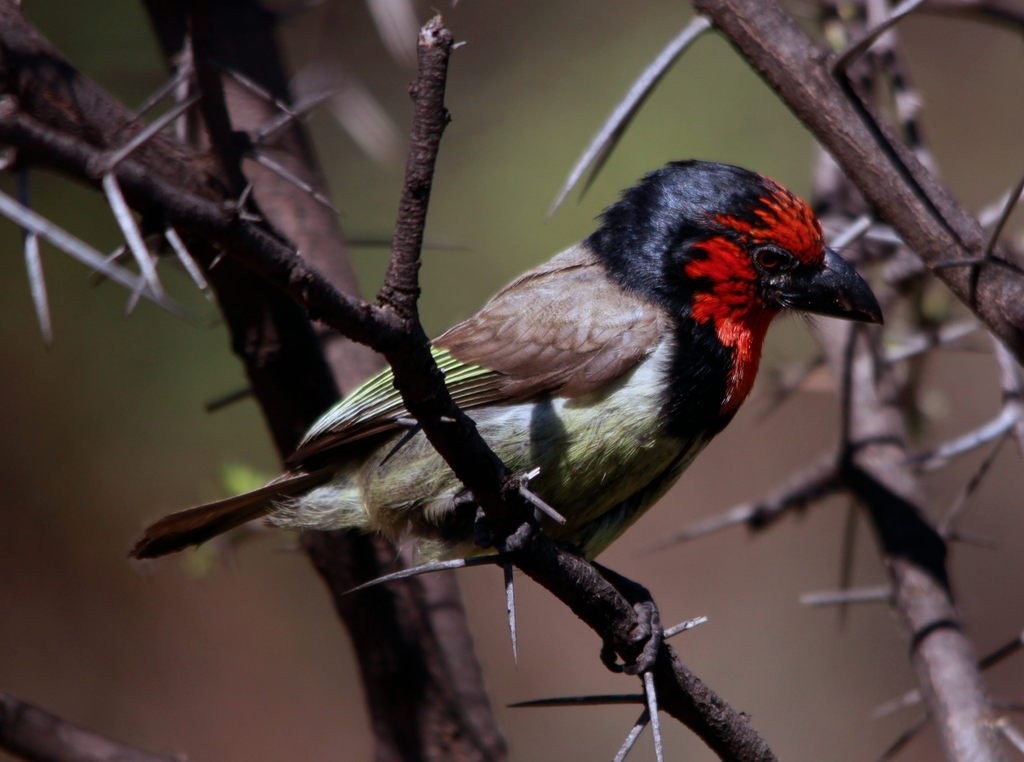
17. Black-collared Barbet
The black-collared barbet usually is about 20–25 cm long, plump-looking and has a large head. It also has the heavy bill fringed with bristles that is characteristic of the genus Lybius. This barbet has a very obvious black collar and head which gives reference to its name. It also has a fire-engine red coloring around the eyes and beak. It has morphologically variable coloring because there is a replacement of a red head with a black head. It also has a more intense color and is larger than other barbets. This bird is also sexually monomorphic, which means that there is generally no phenotypic difference between the males and females of this species. The morphology, size and behavior are basically the same.
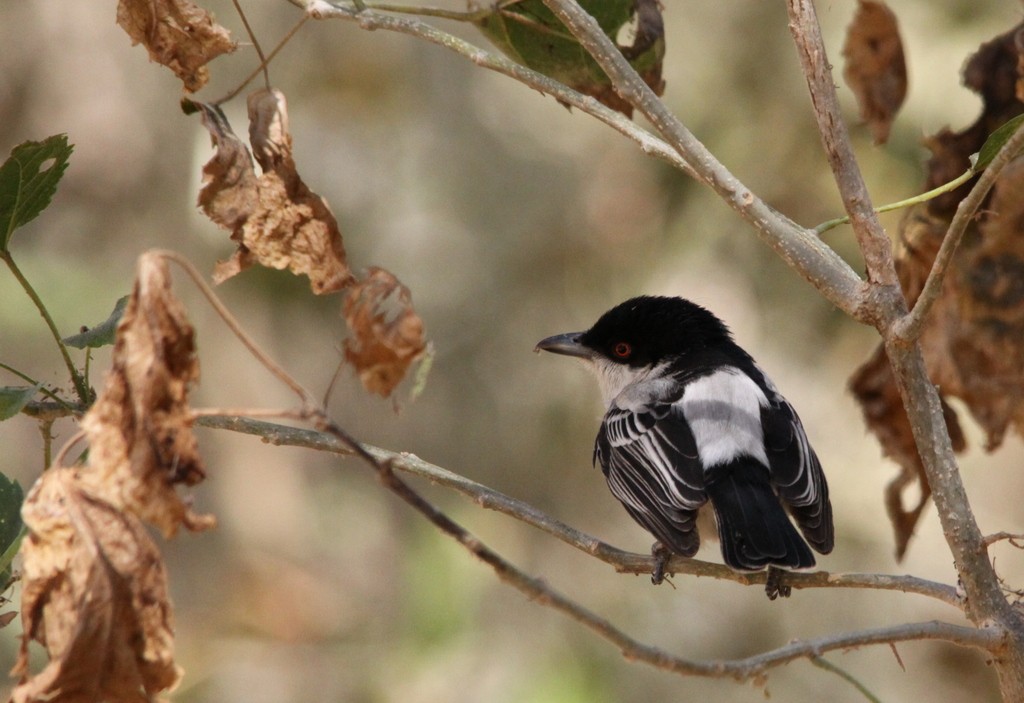
18. Black-backed Puffback
They measure about 17 cm in length, and the sexes are similar though easily distinguishable. Adult males have the upperparts deep blue-black with a slight luster. The black cap subtends the red eye, the upperpart plumage is black-and-white, and the underparts pure white. Females have a black loral stripe and white supraloral feathering, with the ear coverts pale and the crown not solidly black. They also have greyer backs than males, and grey to buffy tones to the white plumage tracts. Immature birds resemble females, but have brownish bills and brown irides, while the upperparts and flanks are still greyer, and the underparts and edges of the wing feathers are yet more buffy. Intraspecific variation is clinal. Range, iris colour, wing markings and the female plumage assist in separating it from other puffback species.
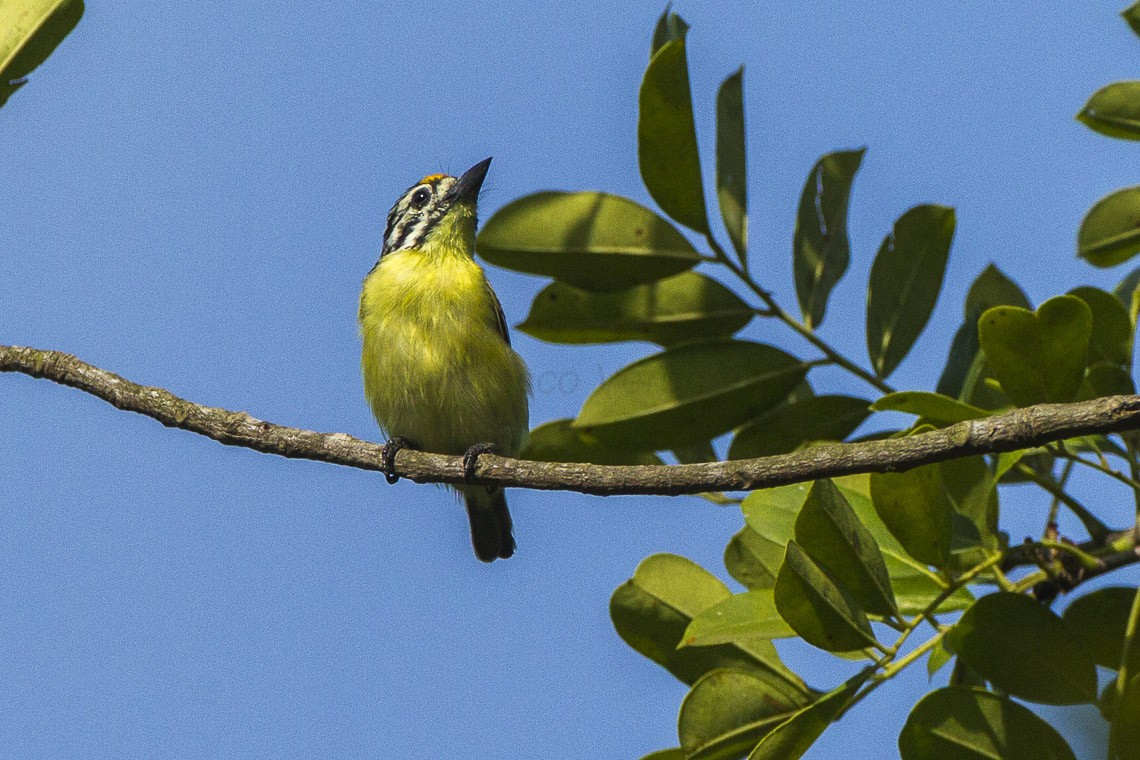
19. Yellow-fronted Tinkerbird
The yellow-fronted tinkerbird is approximately 11 cm (4.3 in) in length. It is plump, with a short neck, large head, and short tail. The adult has black upperparts heavily streaked with yellow and white. Its head has a strong black and white pattern, with a yellow forecrown spot. The underparts and rump are lemon yellow. Both sexes are similar in appearance, but young birds have a differentiating dark crown that lacks the distinct yellow spot.
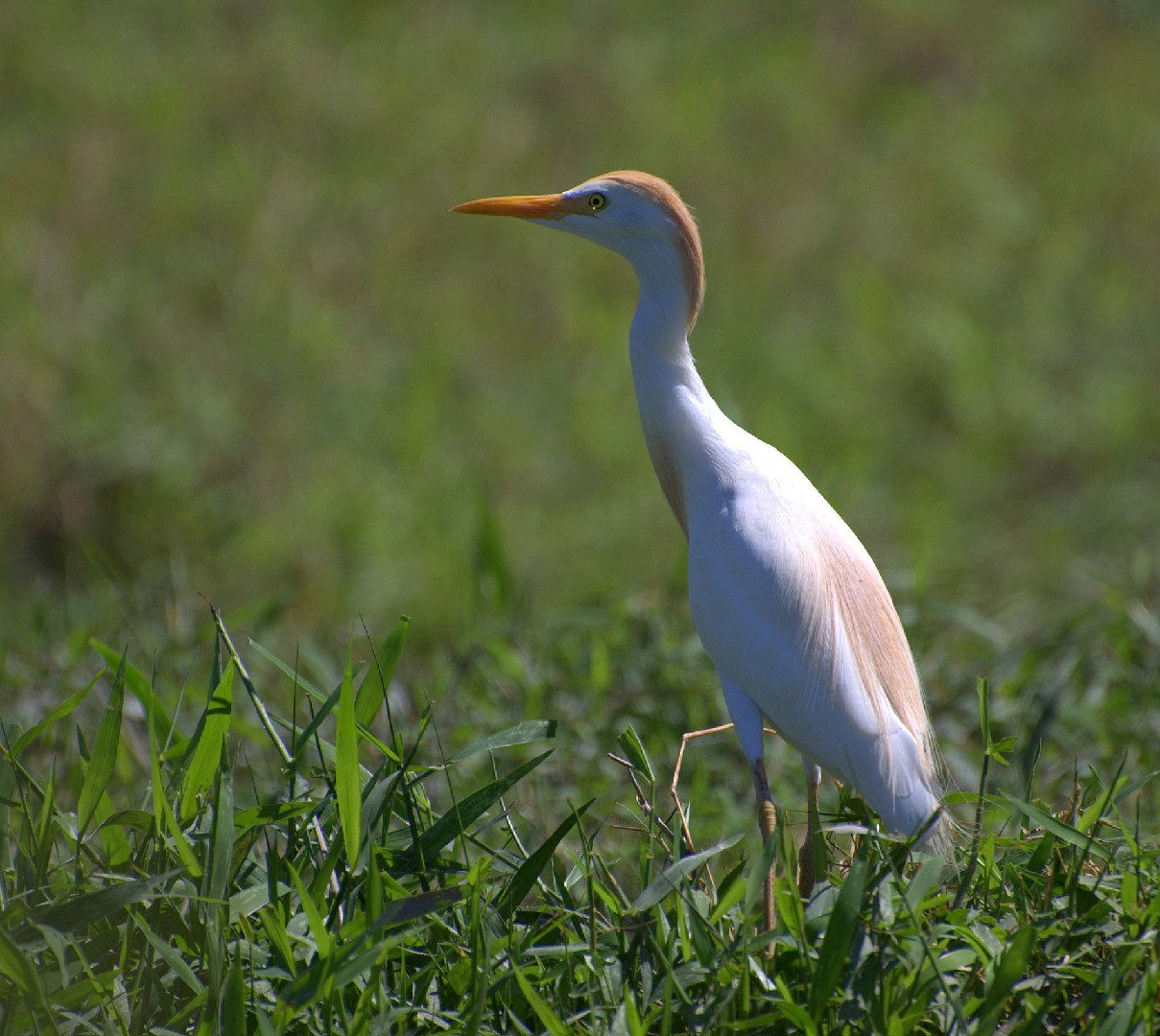
20. Cattle Egret
Cattle Egrets are short, thick-necked egrets. Their name refers to their preference to follow along with livestock as they forage in fields. Cattle Egrets were native only to Africa until the late 1800s when they somehow made their way throughout the Americas. They can often be found along airport runways waiting for planes to take off and blow insects out of the grass and weeds. They also follow behind farm equipment and do the same thing.